
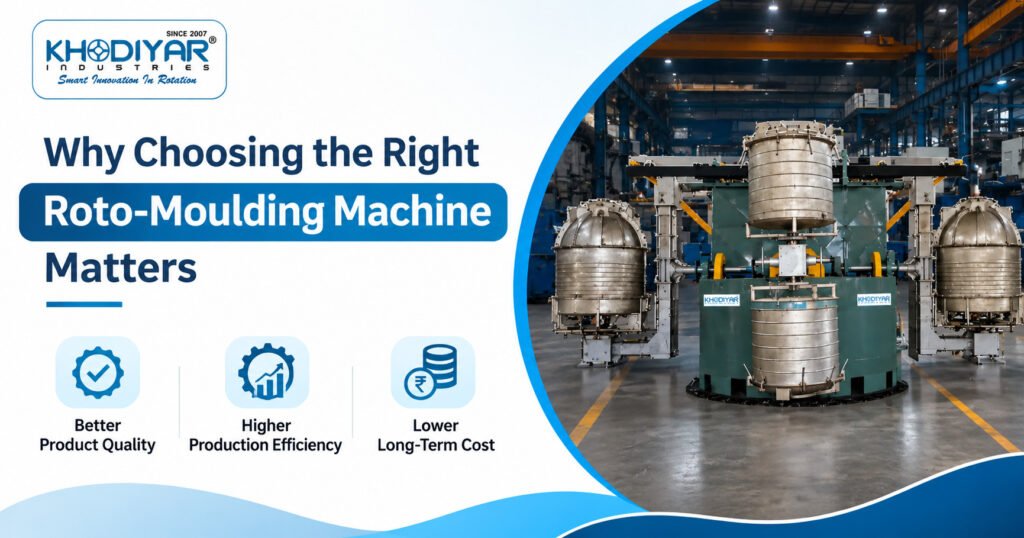
Choosing the right rotomoulding machine matters because it decides your product size range, daily output, fuel cost, product quality and return on investment for years. The right machine matches your largest product, production volume, fuel supply and floor space, and comes from a manufacturer that offers proven designs, clear specifications, installation and long-term service support.
A rotational moulding machine is a long-term investment. Buy one that is too small and you can’t take larger orders. Buy one that is too large, or the wrong type, and you pay for fuel, space and idle capacity you don’t use. This guide explains the main rotomoulding machine types and their applications, what drives rotomoulding machine price, and how to choose a machine and a manufacturer with confidence.
It’s written from the experience of Khodiyar Industries, an Ahmedabad-based rotomoulding machine manufacturer in India, which supplies machines and moulds to customers across India and in African markets.
What Is a Rotomoulding Machine?
A rotomoulding machine (rotational moulding machine) makes hollow, seamless plastic products by heating and rotating a mould filled with plastic powder, usually LLDPE. The process has four stages:
- Loading: a measured amount of powder is placed in the mould.
- Heating and rotation: the mould is heated in an oven, or over burners, while it rotates. The melting powder coats the inside of the mould evenly.
- Cooling: the mould keeps rotating while it’s cooled by air or water spray, so the part sets in shape.
- Demoulding: the mould is opened and the finished part removed.
Because the part forms without pressure, rotomoulding suits large, hollow, stress-free products such as water tanks, at a lower tooling cost than blow or injection moulding.
Why Does Choosing the Right Rotational Moulding Machine Matter?
The machine you choose affects almost every part of your business:
- Product range: the machine’s size and arm capacity set the largest product you can make.
- Output: the number of arms and stations, and the cycle time, decide how many parts you make per shift.
- Fuel cost: oven insulation, burner type and control quality decide how much LPG, CNG or diesel each part uses.
- Product quality: even heating and controlled rotation produce consistent wall thickness and fewer rejects.
- Floor space and civil work: larger machines, and rock and roll pits, need planning before purchase.
- Operating cost and uptime: reliable drives, bearings and controls mean less downtime.
- Return on investment: the right match keeps the machine busy on profitable products.
- Upgrade and resale options: a well-built machine with standard components is easier to upgrade, relocate or resell later.
For more on how machine choice affects output, see our guide to rotomoulding machine productivity factors.
What Are the Main Rotomoulding Machine Types?
The main rotomoulding machine types are bi-axial machines, either multi-arm carousel machines or single-station machines, and rock and roll machines, in open-fire or closed-oven versions. Bi-axial machines rotate the mould on two axes, and suit high-volume production of tanks and containers. Rock and roll machines suit very large, long products.
Bi-Axial Rotomoulding Machine (3 and 4 Arm)
A bi-axial rotomoulding machine rotates the mould around two perpendicular axes, the major and minor arms, inside a closed oven. In a multi-arm design, each arm moves between the oven, the cooling station and the loading station, so one mould heats while another cools and a third is unloaded.
Khodiyar’s 3 and 4 arm bi-axial rotomoulding machines are listed in models from the KI-3/1000 X 2 to the KI-4/5000 X 1. Mould configurations range from 300 L to 5,000 L tanks, depending on the model. Listed features include:
- Cerawool-insulated oven walls
- An imported dual-stage burner suitable for LPG, CNG or diesel
- AC drives for the major and minor arms
- Interchangeable arms
- Pneumatic door closing
- Safety interlocks, with an optional PLC for full automation
Best for: regular, high-volume production of water tanks, dustbins, pallets, road barriers and containers.
Single Station Bi-Axial Machine
A single station machine has one arm and one oven, so it handles a single heating, cooling and loading cycle at a time. It needs less investment and space, and suits start-ups, sampling, development or lower volumes. See Khodiyar’s single station bi-axial machine.
Rock and Roll Rotomoulding Machine
A rock and roll machine rotates the mould 360° on one axis while rocking it on the other. This suits very long or large products.
- Open fire rock and roll: burners heat the mould directly, often over a pit. Khodiyar lists open fire rock and roll machines from model KI-5K (200 L–5,000 L) to KI-50K (listed at 500 L–40,000 L), running on LPG, with a hydraulic power pack and an optional PLC. The company lists the lower investment cost as suited to start-ups.
- Closed oven rock and roll: the mould is heated inside an enclosed oven, which helps retain heat. See Khodiyar’s closed oven rock and roll machine.
Best for: large-capacity water tanks, boats, kayaks, canoes, large-diameter drainage pipes, vehicle bodies and porta cabins.
Other types in the market
Shuttle, clamshell and swing-door machines are also used in the wider industry for specific production layouts. Khodiyar’s range focuses on the bi-axial and rock and roll designs above.
Comparison of rotomoulding machine types
| Type | Rotation | Typical products | Output | Investment | Key consideration |
|---|---|---|---|---|---|
| Multi-arm bi-axial (3 or 4 arm) | Two axes | Tanks, dustbins, pallets, barriers | High (several moulds in different stages) | Higher | Needs steady order volume |
| Single station bi-axial | Two axes | Smaller runs, samples, varied products | Lower | Lower | Simpler, but one cycle at a time |
| Open fire rock and roll | One axis plus rocking | Very large tanks, boats, pipes | Moderate | Lower for the size | Pit and civil work; open heating |
| Closed oven rock and roll | One axis plus rocking | Large, long products | Moderate | Moderate | Better heat retention than open fire |
Bi-Axial or Rock and Roll: Which Should You Choose?
- Choose a multi-arm bi-axial machine if you make standard tanks, dustbins or containers in steady volumes and want several moulds running at once.
- Choose a single station bi-axial machine if you’re starting out, making samples, or running varied products in small batches.
- Choose a rock and roll machine if your products are very large or long, such as tanks above the size a bi-axial oven can hold, boats or pipes, or if you want lower investment for large parts.
Many growing moulders start with one type and add another as their product range expands. Planning floor space for a second machine from the start saves rework later.
What Are the Main Rotomoulding Machine Applications?
Rotomoulding machine applications cover products that need to be hollow, seamless, tough and often large. Common examples, including those listed by Khodiyar:
- Water storage: vertical, horizontal, slimline and loft tanks.
- Sanitation: septic tanks and toilet cabins.
- Waste handling: dustbins and waste containers.
- Logistics: plastic pallets and industrial containers.
- Road safety: road barriers and traffic dividers.
- Agriculture: chemical and water tanks, and feed bins.
- Leisure: boats, kayaks, canoes and playground equipment.
- Infrastructure: large-diameter drainage pipes and roto-lined fittings.
- Automotive and buildings: vehicle bodies, fuel tanks and porta cabins.
Moulds are as important as machines. Khodiyar also supplies roto moulds for tanks, dustbins, pallets and playground equipment.
How to Choose an Industrial Rotomoulding Machine: A Buyer’s Checklist
Start with your products and your volume. Define the largest product, the number of parts per day, your fuel supply and your available space, then choose the machine type, arm configuration and oven size that meet them, with some room to grow.
1. Define your products
- Largest product: its size and capacity, such as a 5,000 L tank.
- Product mix: how many different sizes and moulds you will run.
- Wall thickness and material: LLDPE, HDPE, or multilayer or foam products.
2. Estimate your production volume
- Parts per day and per shift, for each product size.
- Number of shifts, and expected growth over the next 3–5 years.
High, steady volumes favour multi-arm bi-axial machines. Low volumes or very large products may favour single station or rock and roll machines.
3. Match the machine model to your moulds
Check the mould configurations the manufacturer lists for each model. For example, Khodiyar lists its KI-3/1000 X 2 for mould combinations of 1,000 L × 2, 750 L × 2 or 500 L × 4, and its KI-4/5000 X 1 for combinations up to 5,000 L × 2. Confirm the arm load and the oven’s internal size for your exact moulds.
4. Check fuel and energy
- Which fuel is reliably available and affordable at your site: LPG, CNG or diesel?
- What burner type and oven insulation does the machine use?
- What connected load does it need? Khodiyar lists “total load/HP” for each model.
For practical ways to cut fuel use, see how to reduce energy consumption in rotational moulding.
5. Decide on controls and automation
Basic electric panels are simpler. A PLC with an HMI gives repeatable heating, rotation and cooling recipes, alarms and data. Read more in how automation improves rotomoulding production efficiency.
6. Plan space and civil work
Check the machine’s dimensions, which Khodiyar lists per model (from about 11.5 × 11 × 6 m for smaller bi-axial models), along with clearance for mould handling, cooling and storage. Rock and roll machines may need a pit. Khodiyar lists pit sizes for each open-fire model.
7. Plan ancillary equipment
Powder preparation and finishing affect quality and cost. You may need a pulverizer machine, a high speed mixer, a compounding extruder, a scrap grinder and a table cutter.
8. Consider operators and safety
- Operator training at installation.
- Safety interlocks, alarms and guarding.
- Safe handling of fuel, hot moulds and heavy parts.
9. Plan for growth
An industrial rotomoulding machine typically runs for many years, so think beyond the first order. Choose arm capacity and oven size with some headroom, check whether arms are interchangeable, and ask whether automation can be added later if you start with a basic control panel.
What Affects Rotomoulding Machine Price?
Rotomoulding machine price depends mainly on machine type and size, the number of arms, oven construction and insulation, burner quality, the control system (manual, electric or PLC), automation options, the number of moulds included, ancillary equipment, installation scope, and freight and duties for export orders.
Main price factors:
| Factor | Why it affects price |
|---|---|
| Machine type and size | Larger ovens and arms need more steel, insulation and drive capacity |
| Number of arms | Each extra arm adds a drive, structure and mould capacity |
| Burner and fuel system | Imported, dual-stage or multi-fuel burners cost more but can save fuel |
| Oven insulation and doors | Better insulation and sealing raise the initial cost but cut fuel bills |
| Controls and automation | A PLC, HMI and sensors add cost, and add repeatability |
| Moulds | The number, size and complexity of moulds can be a large share of the project |
| Ancillary equipment | Pulverizer, mixer, grinder and cutters |
| Installation and training | On-site commissioning and operator training |
| Export costs | Packing, freight, insurance and import duties |
Because prices depend on configuration, compare quotations on the same scope. Ask for an itemised quote covering the machine, moulds, ancillaries, installation and spares. Contact Khodiyar for a personalised quotation.
Look beyond the purchase price
The cheapest machine isn’t always the cheapest to own. Over its life, also consider:
- Fuel use per part, usually a major running cost.
- Cycle time, which drives output and labour cost per part.
- Reject rate, from uneven heating or poor rotation control.
- Maintenance and spare parts availability.
- Downtime and how quickly the supplier responds.
Why Your Rotomoulding Machine Manufacturer Matters
The manufacturer shapes your results as much as the machine. When comparing a rotomoulding machine manufacturer in India, check:
- Experience with your product types and sizes.
- Clear specifications: published model tables, loads, dimensions and fuel options.
- Machine and mould capability: whether one supplier can supply both, so they work together.
- Installation and training by the manufacturer’s own team.
- After-sales support: response time, spare parts and technical guidance.
- References: installations you can see or contact, ideally in your region.
- Export experience, if you’re outside India: documentation, packing and remote support.
About Khodiyar Industries
Khodiyar Industries has manufactured rotomoulding machines in Ahmedabad, Gujarat since 2007. Its range includes:
- Machines: bi-axial machines (single station, 3-arm and 4-arm) and rock and roll machines (open fire and closed oven).
- Moulds for tanks, dustbins, pallets and playground equipment.
- Ancillary equipment: compounding extruders, high speed mixers, pulverizers, scrap grinders and table cutters.
- Services: consultation, installation, technical guidance and after-sales support, for customers across India and in Africa.
Common Mistakes When Buying a Rotomoulding Machine
- Buying for today’s largest product only. If larger tanks are on your roadmap, check that the oven and arms can handle them.
- Comparing quotes with different scope. One quote may include moulds, ancillaries and installation, and another may not.
- Ignoring fuel supply. A machine set up for a fuel that’s expensive or unreliable at your site raises running costs.
- Underestimating space. Mould handling, cooling and storage need room beyond the machine footprint.
- Skipping powder preparation. Poor powder quality causes defects, however good the machine is.
- Overlooking after-sales support. Long response times for spares or service can cost more than any initial saving.
Questions to Ask Before You Buy
- What is the largest product, and what mould combination, does this model handle?
- What is the expected cycle time for my product, and what assumptions is it based on?
- What fuel does it use, and what is the connected load?
- Which controls are standard, and what automation is optional?
- What does the quote include: moulds, ancillaries, installation, training, spares?
- What are the space and civil requirements, including any pit?
- What warranty and after-sales support are offered, and how quickly?
- Can I see a working installation or speak to an existing customer?
Conclusion
Choosing the right rotomoulding machine means matching the machine type, size, fuel system and controls to your products and volumes, and choosing a manufacturer that can support you for the life of the machine. Start with your largest product and your daily output, compare quotations on the same scope, and look at running costs, not just price. To discuss your requirements, download the Khodiyar brochure or contact the team. If you’re buying for export, also ask about packing, shipping documents and remote commissioning support.
FAQ section
What is a rotomoulding machine?
A rotomoulding machine heats and rotates a mould containing plastic powder, usually LLDPE, so the melted plastic coats the inside of the mould and forms a hollow, seamless part such as a water tank.
What are the main rotomoulding machine types?
The main types are bi-axial machines (single station, 3-arm or 4-arm) and rock and roll machines (open fire or closed oven). Shuttle and clamshell machines are also used in the wider industry.
What is a bi-axial rotomoulding machine?
A bi-axial machine rotates the mould around two perpendicular axes inside an oven. Multi-arm models heat, cool and load different moulds at the same time, suiting high-volume production of tanks and containers.
When should I choose a rock and roll machine?
Choose a rock and roll machine for very large or long products, such as large tanks, boats, kayaks and drainage pipes. Khodiyar lists open-fire models for tanks of up to 40,000 litres.
What affects rotomoulding machine price?
The main factors are machine type and size, number of arms, burner and fuel system, oven insulation, controls and automation, moulds, ancillary equipment, installation and, for exports, freight and duties.
What are the main rotomoulding machine applications?
Water tanks, septic tanks, dustbins, pallets, road barriers, playground equipment, boats and kayaks, drainage pipes, vehicle bodies and industrial containers.
Which fuel is used in rotational moulding machines?
LPG, CNG and diesel are common. Khodiyar’s bi-axial machines are listed for LPG, CNG or diesel, and its open-fire rock and roll machines for LPG.
How do I choose a rotomoulding machine manufacturer in India?
Check experience with your products, published specifications, mould capability, installation and training, after-sales support, references and, for exports, international shipping experience.
Does Khodiyar supply moulds as well as machines?
Yes. Khodiyar supplies roto moulds for tanks, dustbins, pallets and playground equipment, as well as ancillary equipment such as pulverizers and mixers.
Do Khodiyar machines come with automation?
PLC automation is listed as an option on Khodiyar’s bi-axial and open-fire rock and roll machines, with electric control panels as standard on the bi-axial range.