


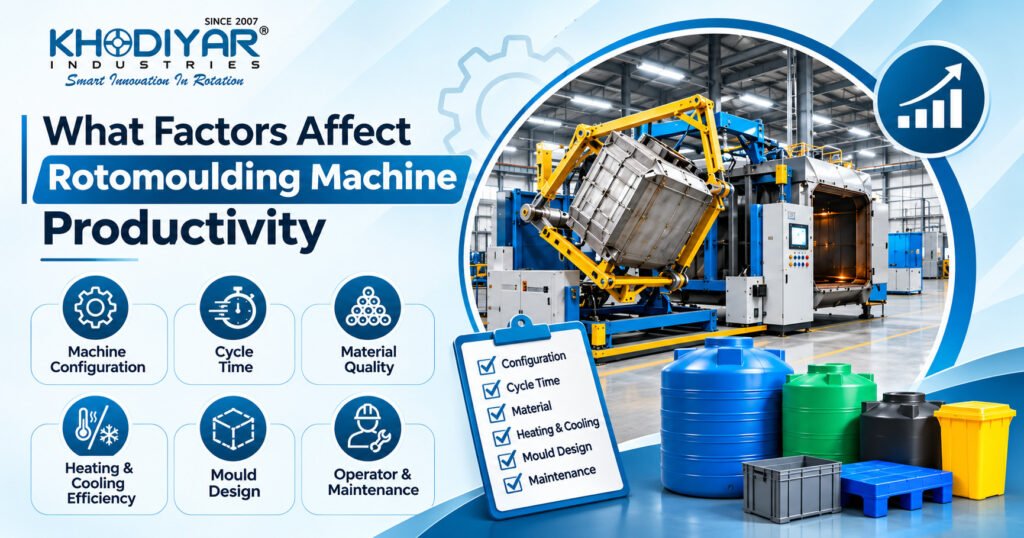
Rotomoulding machine productivity depends mainly on cycle time (heating, cooling, loading and demoulding), machine configuration (single station, multi-arm or rock and roll), mould design and material, powder quality, oven and burner efficiency, rotation settings, and how well the shop manages labour, maintenance, scheduling and quality control. The fastest gains usually come from balancing arm times, controlling the cure with temperature data, optimising cooling and cutting unplanned downtime.
In rotational moulding, the machine rarely runs as fast as its brochure suggests. A plant can own a well-built rotomoulding machine and still produce far less than its rated output, because productivity is decided by the whole process: the mould, the powder, the oven, the cooling station, the operators and the production plan.
For manufacturers of water tanks, chemical tanks, loft tanks, road barriers, kayaks and industrial containers, that gap matters. Every minute saved per cycle adds up to more litres per shift, lower fuel cost per kilogram and faster delivery.
This guide explains how to measure productivity, which factors affect it most, and how to improve output without weakening the product. It draws on the practical experience of Khodiyar Roto, an Ahmedabad-based manufacturer of rotomoulding machines, moulds and ancillary equipment since 2007.
How Rotomoulding Machine Productivity Is Measured
Before improving anything, define what you’re measuring. Four numbers matter most.
1. Rotomoulding cycle time
Rotomoulding cycle time is the time to produce one batch on one arm or station:
Cycle time = loading + heating + cooling + demoulding (+ any waiting time)
On a multi-arm machine, the arms move between stations together, so the slowest station sets the pace. If heating takes 18 minutes but cooling takes 24, every arm waits for the cooling station, and the oven sits idle for 6 minutes per index.
2. Rotomoulding machine production capacity
Rotomoulding machine production capacity is the output a machine can achieve over a period:
Output per hour = (60 ÷ index time in minutes) × products per index
Daily output (kg) = output per hour × part weight (kg) × productive hours
For example, as an illustration only: a 3-arm machine indexing every 20 minutes, with one 1,000-litre tank (about 18 kg) per arm, produces 3 tanks per hour. Over 20 productive hours, that’s 60 tanks, or about 1,080 kg.
3. Rotomoulding machine efficiency (OEE)
Overall equipment effectiveness is a useful single measure of rotomoulding machine efficiency:
OEE = Availability × Performance × Quality
- Availability = actual running time ÷ planned production time
- Performance = (ideal cycle time × total output) ÷ running time
- Quality = good parts ÷ total parts
A machine that runs 85% of planned time, at 90% of its ideal speed, with 95% good parts, has an OEE of about 73%. Tracking each element tells you whether to focus on downtime, speed or rejects.
4. Energy per good kilogram
Fuel or energy per good kg = fuel or energy used ÷ kg of good parts produced
This exposes hidden losses: overcooking, oven heat escaping through poor seals, and rejected parts that consumed full fuel.
Machine Design Factors
The machine sets the ceiling for productivity.
Machine configuration
| Configuration | How it works | Productivity profile |
| Single station bi-axial | One arm heats, cools and is loaded in the same position | Simple and low cost; the oven is idle during cooling and loading |
| Multi-arm (3 and 4 arm) bi-axial | Arms rotate between oven, cooling and loading stations | The oven works almost continuously; highest output for regular production |
| Close oven rock and roll | The mould rocks on one axis and rotates on the other inside an enclosed oven | Suits long and very large parts; enclosed oven retains heat |
| Open fire rock and roll | Direct flame heating of the mould, without a closed oven | Flexible for very large tanks; heat efficiency depends heavily on operator control and burner setup |
Khodiyar Roto’s range includes bi-axial, 3 and 4 arm bi-axial, single station bi-axial, close oven rock and roll and open fire rock and roll machines. Our guide on how to choose the right rotomoulding machine compares them in more detail.
Oven and burner design
Heating is usually the longest step, so oven design has a direct effect on cycle time:
- Insulation and door seals reduce heat loss and fuel use.
- Burner capacity and air circulation decide how quickly and evenly the mould heats.
- Even airflow prevents hot and cold spots that cause thin walls or local over-curing.
- Oven recovery time, how quickly the oven returns to set temperature after the door opens, affects every cycle on a multi-arm machine.
Arm design and swing
Arm strength, swing diameter and load capacity limit how many moulds, and how large, can run per arm. Mounting several smaller moulds on one arm, where weight and swing allow, can multiply output without adding cycle time.
Controls
Manual controls rely on operator judgement. PLC-based controls store recipes for temperature, time and rotation, which improves repeatability and reduces rejects caused by human variation.
Mould, Resin and Powder Factors
Mould quality
The mould is often the hidden bottleneck.
- Mould material and wall thickness: thinner, more conductive moulds (for example, cast or sheet aluminium) heat and cool faster than heavy steel moulds, but must still be rigid enough for the part.
- Venting: a correctly sized, clean vent prevents pressure build-up, blowholes and distortion. Blocked vents cause rejects and can push material out of parting lines.
- Parting lines and clamps: poor fit leads to flash, leaks and extra trimming time.
- Surface condition and release agent: a clean, correctly treated surface speeds demoulding and reduces sticking.
- Design for demoulding: draft angles and sensible features cut demoulding time.
See Khodiyar Roto’s roto moulds range for tank and industrial moulds.
Resin and powder characteristics
Most rotomoulded products use polyethylene, especially LLDPE. The powder’s behaviour affects how evenly and quickly the wall forms:
| Powder property | Why it matters for productivity |
| Particle size (commonly around 35 mesh, about 500 µm) | Finer, consistent powder melts faster and forms a more even wall |
| Particle shape and dry flow | Free-flowing, rounded particles spread evenly; “tails” from poor grinding cause bridging and voids |
| Bulk density | Higher bulk density improves packing and reduces bubbles |
| Melt flow index (MFI) | Affects how easily the melt flows and fuses; must match the product’s strength needs |
| UV and thermal stabilisers | Protect against degradation, allowing a stable process window |
| Moisture and contamination | Cause bubbles, pinholes and rejects |
Grinding and compounding in-house gives more control. A pulverizer controls particle size, a high speed mixer blends colour and additives, and a compounding extruder produces consistent, stabilised compounds.
Heating, Cooling and Rotation
Heating
The aim is to fully melt and densify the powder without degrading it. Under-cured parts show bubbles, poor impact strength and rough inner surfaces; over-cured parts discolour, become brittle and waste fuel.
Experienced moulders monitor the internal air temperature inside the mould with a data logger. The peak internal air temperature is a far better guide to correct cure than oven time alone, and it allows heating time to be reduced safely to the minimum that still gives good properties. The right target depends on the resin, so confirm it with your material supplier.
Cooling
Cooling often takes as long as heating and is the most common bottleneck on multi-arm machines.
- Forced air with fans is standard.
- Water mist or spray cools faster, but applied too early or too hard it can cause warpage and shrinkage problems.
- Staged cooling, starting with air and adding water later, balances speed and shape.
- Internal cooling or low internal mould pressure can reduce cooling time; research from Queen’s University Belfast reported cooling time reductions of up to 40% using such techniques.
The goal is to cool as fast as the part allows without distortion.
Rotation speed and ratio
Bi-axial machines rotate the mould on two axes. Speeds are low, and the ratio between the major and minor axes controls how evenly powder coats the mould. Ratios around 4:1 are a common starting point for regular shapes, adjusted for long, flat or unusual parts. A poor ratio causes thick and thin areas, which forces longer heating to cure the thickest section.
Operational Factors: Labour, Automation, Maintenance and More
These factors affecting rotomoulding process output are often the easiest to improve.
Labour and loading
Loading powder, closing clamps, demoulding and preparing the mould can take as long as heating on a multi-arm machine. Standard work, pre-weighed powder charges, quick-release clamps and trained crews reduce this time and its variation.
Automation
PLC recipes, automatic temperature control, rotation control and data logging reduce dependence on individual operators and make it easier to repeat the best cycle every time.
Maintenance
Unplanned downtime destroys availability. Common causes include burner faults, worn bearings and gears, chain or drive problems and electrical failures. A preventive maintenance schedule, a stock of critical spares and daily checks keep machines running.
Energy use
Track fuel or energy per good kilogram. Poor door seals, damaged insulation, long door-open times and overcooking all increase cost without increasing output. The how to choose guide notes typical fuel use per cycle for single station machines.
Batch size and scheduling
Frequent mould and colour changes cost time. Group similar products by wall thickness and cure temperature so that moulds on the same machine need similar oven times. On multi-arm machines, balance arms so that no single mould slows the whole carousel.
Quality control
Rejects consume full fuel and machine time. Simple checks, such as wall thickness measurement, impact testing on sample parts, visual inspection and weight checks, catch problems early. Recycle scrap with a scrap grinder where specifications allow.
How to Improve Rotomoulding Productivity
Follow these steps for structured rotomoulding process optimization.
- Measure your baseline. Record every stage of the cycle, downtime events and reject rates for at least two weeks. Calculate OEE and energy per good kg.
- Find the bottleneck station. On multi-arm machines, compare heating, cooling and loading times. Improve the slowest one first.
- Control the cure with data. Use internal air temperature monitoring to set the minimum heating time that gives full properties.
- Optimise cooling. Introduce staged air and water cooling, and test internal cooling or mould pressurisation where suitable.
- Balance the arms. Match mould combinations on each arm so that their heating needs are similar.
- Speed up loading and demoulding. Pre-weigh charges, standardise tools and train crews.
- Improve powder quality. Check particle size, dry flow and bulk density regularly.
- Maintain moulds. Clean vents, check parting lines and refresh release agents on a schedule.
- Plan production. Reduce changeovers by grouping products and colours.
- Prevent breakdowns. Follow a preventive maintenance plan and keep critical spares.
Improving Productivity Without Compromising Product Quality
Faster cycles are only valuable if the parts still perform. Shortcuts that look like productivity gains often create failures in the field.
| Shortcut | Risk |
| Cutting heating time without temperature data | Under-cured parts with low impact strength and internal bubbles |
| Raising oven temperature to “cook faster” | Outer surface degradation, discolouration and brittle walls |
| Aggressive early water cooling | Warpage, uneven shrinkage and residual stress |
| Lighter shot weights to save material | Thin walls that fail capacity or pressure requirements |
| Skipping mould maintenance | Flash, leaks, blowholes and more trimming |
Protect quality by validating every change: test wall thickness, impact strength and appearance before and after, and update the recipe only when results meet specification. For water tanks, check the relevant product standard required by your customers.
Conclusion
Rotomoulding machine productivity is not decided by the machine alone. It depends on the balance of heating, cooling and loading times, the quality of moulds and powder, the skill of operators and the discipline of maintenance, scheduling and quality control.
Start by measuring your cycle and OEE, fix the bottleneck station, control the cure with data and protect quality at every step. Small, validated improvements add up to significantly more output from the same machine.
Planning a new line or upgrading an existing one? Contact Khodiyar Roto to discuss machine configuration, moulds and ancillary equipment for your products, or download our brochure.
Frequently Asked Questions
It is the amount of good product a rotomoulding machine produces in a given time. It depends on cycle time, machine configuration, uptime and reject rate, and is often measured as parts or kilograms per hour, or as OEE.
Heating and cooling usually take the longest. Wall thickness, mould material, oven efficiency, powder quality and cooling method have the biggest influence on how long each takes.
Divide 60 by the index time in minutes, multiply by the number of products per index to get output per hour, then multiply by part weight and productive hours to get daily output in kilograms.
Usually, yes, for regular production. A multi-arm machine keeps the oven heating while other arms cool and load, so the oven is rarely idle. Single station machines suit lower volumes, prototypes and very large parts.
Use staged cooling, combining forced air with controlled water mist, and consider internal cooling or low internal mould pressure where suitable. Cool as fast as the part allows without warpage.
Yes. Consistent, free-flowing powder of the right particle size melts faster, forms even walls and reduces bubbles and rejects.
Preventive maintenance reduces unplanned breakdowns, keeps burners, drives and bearings working properly, and protects availability, which is one of the three parts of OEE.
Yes. PLC recipes, temperature control and data logging make cycles repeatable, cut operator variation and reduce rejects.
There is no published benchmark specific to rotomoulding. Across manufacturing, 85% is often quoted as world-class, but rotomoulding plants with frequent mould changes usually run lower. The most useful target is steady improvement on your own measured baseline.
Change one variable at a time, monitor internal mould temperature, and test wall thickness, impact strength and appearance before adopting any faster cycle.