


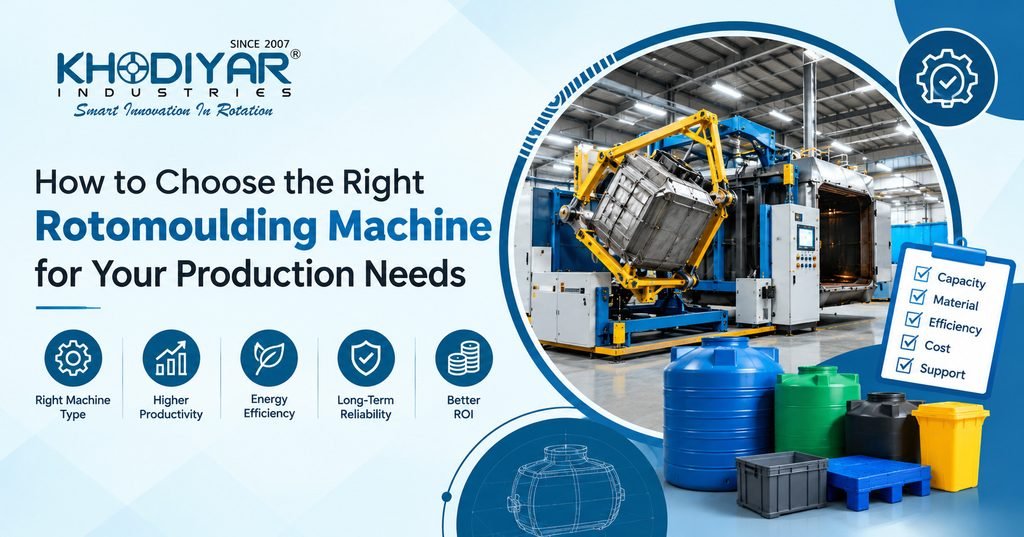
Rotational moulding, or rotomoulding, makes large, hollow, one-piece plastic products. The Institute of Polymer Technology at Friedrich-Alexander-Universität Erlangen-Nürnberg (FAU) describes it as a process capable of producing “seamless hollow structures with very low residual stresses”, in sizes up to more than 100,000 litres.
Typical products include:
- Water and storage: overhead water tanks, loft tanks, septic tanks and chemical storage tanks
- Industry and agriculture: pallets, bins, ducts, chemical containers and spray tanks
- Roads and safety: road barriers, traffic cones and dividers
- Consumer and leisure: insulated ice boxes, kayaks, playground equipment and planters
In India, water storage tanks are among the most common rotomoulded products. The Bureau of Indian Standards covers them under IS 12701, “Rotational Moulded Polyethylene Water Storage Tanks”, which includes cylindrical vertical and rectangular loft tanks in single or multiple layers.
Why the right machine matters for production efficiency
The machine decides four things that shape your profit for years:
- Output per day: how many products you can make per shift.
- Product range: the largest and longest product you can mould.
- Running cost per part: fuel, electricity and labour for every tank.
- Quality: how consistently you hold wall thickness and avoid rejects.
Good rotomoulding machine selection balances all four against your budget, rather than optimising one and paying for it in the others.
Understanding Rotomoulding Machines
Definition and working principle
A rotomoulding machine heats a hollow metal mould filled with plastic powder while rotating it, then cools it while it keeps turning. Every cycle has four steps:
- Load: a measured amount of plastic powder goes into the mould.
- Heat and rotate: the closed mould is heated while it turns slowly. The powder melts and coats the inside of the mould evenly.
- Cool: the mould keeps rotating while it cools, so the part sets in shape.
- Demould: the finished part is removed, and the cycle starts again.
Because no pressure is used, the moulds are simpler and cheaper than those for injection or blow moulding, which is why rotomoulding suits large parts in moderate volumes.
Types of rotomoulding machines available in the market
The main machine types differ in how they rotate the mould and how they apply heat:
- Single station bi-axial machines. One mould station rotates on two perpendicular axes inside an oven. They suit round and symmetrical products, start-ups and mid-size plants.
- Multi-arm bi-axial machines (3 and 4 arm). Several arms carry moulds through heating, cooling and loading stations at the same time, so the oven is rarely idle. They suit high-volume production of a varied product mix.
- Close oven rock n roll machines. The mould rotates on one axis and rocks on the other inside an insulated oven. They suit long or large products.
- Open fire rock n roll machines. The mould rocks and rotates over open burners, usually in a pit. They suit very large tanks and special products at a lower capital cost.
The table below shows how these types compare in Khodiyar’s published specifications:
| Machine type | Best suited to | Size range in Khodiyar’s specifications | Notes |
|---|---|---|---|
| Single station bi-axial | Round and symmetrical tanks; start-ups and mid-size plants | Up to 2,000 L per mould (KI-2000 x 2) | 6.5–13 HP; diesel or gas |
| 3 and 4 arm bi-axial | High-volume production of a varied product mix | Up to 5,000 L per mould (KI-3/5000 and KI-4/5000) | 19–48 HP; LPG, CNG or diesel burners; optional PLC |
| Close oven rock n roll | Long or large products, with heat contained in an insulated oven | Up to 10,000 L (KI-10K) | 7–14.5 HP; LPG; 20,000–60,000 L per 12 hours |
| Open fire rock n roll | Very large tanks and special products at low capital cost | 200–40,000 L across models (KI-5K to KI-50K) | 13–34 HP; LPG; needs a pit |
Key Factors in Rotomoulding Machine Selection
The core machine selection factors are production capacity, material, size and footprint, energy and running costs, and automation. Fix these before you compare brands or prices.
1. Production capacity requirements
Start with numbers, not models:
- Your products: list every product you will make in the next three to five years, with capacity and dimensions.
- Demand: estimate realistic daily or monthly volumes for each product, including peaks such as summer demand for water tanks.
- Shifts: decide whether you will run one shift, two, or 24 hours.
Then compare against published output. On our single station bi-axial machines, for example, the rated production over 24 hours is 36,000 litres on the KI-1000 x 2, 64,000 litres on the KI-1000 x 4 and 70,000 litres on the KI-2000 x 2.
Divide your monthly demand by your working days and shifts, and you can quickly see which class of machine you need. If your demand sits right at a machine’s limit, size up or plan for a second machine. Running flat out leaves no room for mould changes, maintenance or growth.
Multi-arm machines raise output because the arms work in parallel: while one arm is in the oven, another cools and a third is unloaded and recharged. Consider stepping up from a single station when:
- your oven regularly sits idle while moulds cool or are recharged;
- you run more than one shift to meet demand;
- you need to run several products at once without changing moulds between batches.
2. Material compatibility and processing capabilities
Most rotomoulded products are made from polyethylene. FAU notes that polyethylene accounts for over 80% of the materials used in the process. LLDPE is the usual grade for tanks; HDPE suits stiffer parts; polypropylene, nylon and PVC are used for specific applications.
Material affects choosing roto moulding machine features in three ways:
- Heat control: each polymer has its own processing window. The burners and controls must hold steady oven temperatures for the materials you plan to run.
- Multi-layer products: many water tanks have two or more layers, such as a coloured outer layer and a food-grade inner layer. Multi-layer charging needs access to the mould during the cycle. Our 3 and 4 arm machines offer an optional hydraulic lift for this, and our single station machines are designed for double, triple, four-layer or foam-layer tanks.
- Powder supply: rotomoulding needs fine powder, not granules. If you plan to grind your own, budget for a pulverizer machine, and for a scrap grinder to reuse trimmings and rejects where the product specification allows.
3. Machine size and footprint considerations
Size the machine for your largest and longest product, not your average one, and then check that it fits your site.
- Floor area: multi-arm machines need a large space. In our specifications, 3 and 4 arm machines range from 11.5 × 11 × 6 metres to 19 × 14 × 7.5 metres for the KI-4/5000 x 1.
- Pits: open fire rock n roll machines are installed over a pit, which measures 8 × 5 × 4 metres for our largest model.
- Height and handling: confirm roof height, crane or hoist access, and the space to store and change moulds.
- Utilities: check power supply for the connected load and safe space for fuel storage.
A machine that arrives before the shed is ready, or that does not fit under the roof, delays production by weeks.
4. Energy efficiency and operational costs
Heating is the largest running cost in rotomoulding, so compare fuel use per cycle and the fuels available at your site:
- Our single station bi-axial machines list 5.5 to 9 litres of diesel, or 4.2 to 6.9 kg of gas, per cycle, depending on the model.
- Our 3 and 4 arm machines use double-stage burners suited to LPG, CNG or diesel; our rock n roll machines run on LPG.
Then look at how the oven keeps heat in:
- Insulation: our 3 and 4 arm ovens use Cerawool insulation, and our close oven rock n roll machine has a fully insulated oven with 75 mm walls.
- Door sealing: pneumatic cylinders close the oven doors tightly.
- Burner control: auto-ignition and adjustable burners.
Cooling matters too. Research at Queen’s University Belfast reports that its Rotocooler system “reduces cooling times for the rotomoulding process by up to 40% with production rate increase by up to 15%”. Faster, well-controlled cycles mean more parts from the same fuel.
Always compare cost per litre of product, not just the price of the machine. A cheaper machine that burns more fuel per cycle can cost more within a few years.
5. Automation features and technology integration
Rotomoulding machines range from simple manual operation to PLC-controlled automation:
- Manual or semi-automatic machines are simpler, cost less and suit lower volumes. Open fire machines keep the process “fully visual”, so operators can see and correct problems quickly.
- Electric control panels and AC drives give consistent arm speeds and easier adjustment. All of our 3 and 4 arm models use AC drives for major and minor arm movement.
- PLC automation stores proven settings, or recipes, for each product and repeats them every cycle. This reduces operator variation, an important source of rejects. On our 3 and 4 arm and rock n roll machines, a PLC is available as an option.
- Process monitoring: tools that measure the temperature inside the mould help operators judge when a part is ready. Queen’s University Belfast developed Rotolog, described in its research impact case study as the first commercial process control system for rotomoulding.
More automation is not automatically better. It pays where you run long batches of repeat products and where skilled operators are hard to retain. For a small range of products on one shift, a well-built semi-automatic machine may give a faster payback.
How to Choose a Rotomoulding Machine: A Practical Guide
Step-by-step guide to evaluating your needs
- List your products. Record capacity, dimensions, shape (round, long or flat) and number of layers for each.
- Set volume targets. Estimate daily output for each product, now and in three years.
- Pick the machine type. Use product shape and size: bi-axial for round tanks up to the specification limit, rock n roll for long or very large products.
- Size the capacity. Choose a model whose mould combinations fit your largest product and whose rated output meets your target with some margin.
- Check your site. Confirm floor area, height, pit requirements, power and fuel.
- Decide on automation. Choose manual, semi-automatic or PLC based on volume, product mix and the operators available.
- Compare total cost. Include moulds, installation, fuel per cycle and support, not just the machine price.
Assessing your production process
Before you buy, walk through your whole process, not just the machine:
- Powder preparation: will you buy powder or grind it in-house?
- Moulds: each product needs its own roto mould, and mould quality affects cycle time and finish.
- Finishing: trimming, fitting inserts and testing take time and space after demoulding.
- Bottlenecks: if finishing or mould changes are slow, a faster machine will not increase output.
A machine should fit your process, not force you to rebuild everything around it.
Analysing your budget and financial constraints
Budget for the total cost of ownership:
- Machine price: compare the same capacity, number of arms and features.
- Moulds: often a large share of the start-up budget.
- Installation: foundations, pit (for open fire machines), electrical supply and fuel connection.
- Running costs: fuel, electricity, labour and maintenance per part.
- Downtime risk: lost production while waiting for parts or service.
If capital is tight, a single station or open fire machine can get production started at a lower investment. You can then add a multi-arm machine as orders grow. Ask every supplier for rated fuel use, connected load and output, and calculate the cost per litre of product.
Evaluating manufacturers
Once you know which machine you need, compare who builds it:
- Track record: how long has the company built rotomoulding machines, and can you visit a working installation?
- Published specifications: clear tables of capacity, connected load, fuel use and output are easier to compare and to hold a supplier to.
- Quality systems: ask for current quality certificates, such as ISO 9001, and check the issue and expiry dates printed on each one.
- Customisation: can the supplier adapt arm configuration, oven size or controls to your products?
Common Mistakes to Avoid
Overlooking production scalability
Buying only for today’s product is the most common error. A machine that fits your 1,000-litre tank cannot make the 2,000-litre tank your next customer wants. Plan for the products you expect in three to five years, or choose a machine that can be expanded, such as a multi-arm machine with interchangeable arms.
The opposite mistake also costs money: an oven far larger than you need runs half-empty and burns fuel on unused space. Size for realistic demand, with a margin, not for “just in case”.
Ignoring after-sales support and service
A rotomoulding machine works in heat and dust for years. Before you buy, get written answers to these questions:
- What does the warranty cover, and for how long?
- Who installs and commissions the machine, and is operator training included?
- How quickly can burners, motors, bearings and seals be supplied?
- How fast can a service engineer reach your plant?
A low-cost machine with no local service can sit idle for days waiting for a part, wiping out any saving on the purchase price.
Failing to consider future technological advancements
Technology in rotomoulding is moving towards better measurement and control:
- Process monitoring of internal mould temperature, as pioneered by Rotolog, helps standardise cycles.
- Faster cooling, such as the Rotocooler approach, raises output from the same oven.
- New heat sources are being studied. An article in Plastics Engineering, the Society of Plastics Engineers’ journal, describes a solar heating concept for rotational moulding, based on a simulation rather than a running plant.
You don’t need every new feature on day one. Choose a machine whose control panel, burners and drives can be upgraded, for example with an optional PLC added later, so it can keep pace as your plant grows.
Case Studies and Examples
Published case studies of individual rotomoulding plants are scarce, so we have used sources you can check, plus clearly labelled illustrative examples.
Success story: faster cycles through better process control (Queen’s University Belfast)
Researchers at Queen’s University Belfast developed Rotolog, a process control system that measures the temperature inside the mould, and later the Rotocooler, an energy-saving cooling system. According to the university’s research impact case study, the Rotocooler reduces cooling times by up to 40% and increases production rates by up to 15%. It was licensed to the German company Maus in 2013.
Lesson: the machine’s ability to control heating and cooling, not just its size, decides how much you produce per shift.
Worked example: matching machine size to volume (Khodiyar specifications)
Our published specifications for single station bi-axial machines show how capacity affects fuel per litre:
| Model | Mould load per cycle | Diesel per cycle | Rated output per 24 hours |
|---|---|---|---|
| KI-1000 x 2 | 2 × 1,000 L | 5.5 L | 36,000 L |
| KI-1000 x 4 | 4 × 1,000 L | 7 L | 64,000 L |
Doubling the mould load per cycle raises rated diesel use per cycle by about 27%, while rated daily output rises by about 78%. The connected electrical load also doubles, from 6.5 to 13 HP. These are rated figures, not a customer’s measured results.
Lesson: for a plant with steady demand for 1,000-litre tanks, the larger model can lower fuel per litre. For a plant with low or uncertain demand, the smaller model keeps capital and running costs down.
Lessons from poor machine selection (illustrative)
The scenarios below are illustrative examples of common situations, not individual customer stories.
- The undersized start-up: a new tank maker buys a machine for 1,000-litre tanks, then wins an order for 2,000-litre tanks it cannot produce.
- The oversized oven: a plant buys the largest machine it can afford “for the future”, then runs it half-empty for two years with high fuel cost per tank.
- The unprepared site: a machine arrives before its pit is dug and waits weeks to be installed.
- The unsupported machine: a low-cost machine from a distant supplier sits idle while a burner part is shipped.
Each of these could have been avoided with the step-by-step check above.
Conclusion
Rotomoulding machine selection comes down to matching the machine to your products, volumes, process and site, then choosing a manufacturer you can rely on for years. The key takeaways:
- Define your products and volumes first, including the largest product you will make.
- Choose the machine type by product shape and size: bi-axial for round tanks, rock n roll for long and very large products.
- Compare real specifications: capacity per mould, connected load, fuel per cycle and rated output.
- Match automation to your volume and team, and choose controls that can be upgraded.
- Judge the total cost of ownership, not just the purchase price.
- Insist on clear warranty, spares and service commitments.
Take the time to research, visit working installations and ask suppliers for their specification tables. If you are planning a new plant or expanding an existing one, contact our team to compare machine types for your products, or download our brochure for full specifications.
Frequently Asked Questions
How do I choose the right rotomoulding machine?
List your products, the largest part size, monthly volumes and materials. Use these to work out how many arms you need and which machine type fits, from rock and roll and clamshell to shuttle and carousel. Then compare heating, cooling and control features, total cost of ownership and after-sales support from at least three manufacturers.
What are the most important machine selection factors?
The four core machine selection factors are production volume, material compatibility, machine size and footprint, and automation level. After these, compare heating and cooling features, control systems, total cost of ownership and the manufacturer’s support.
Is a manual or automatic rotomoulding machine better?
Manual machines cost less and are simple to repair, so they suit start-ups and low volumes. Semi-automatic and fully automatic machines cost more but give more consistent parts, less scrap and lower labour per part. They are usually the better choice for higher volumes and multi-shift production.
Which rotomoulding machine is best for water tanks?
For large tanks at moderate volumes, rock and roll machines are a common, economical choice. For higher volumes and a wider range of tank sizes, shuttle and carousel (bi-axial) machines give more output. Carousels are most productive when cycle times are similar.
What should I ask a rotomoulding machine manufacturer before buying?
Ask for oven internal size, swing diameter, arm load capacity, burner rating, insulation details and expected fuel use per cycle. Also ask what the warranty covers, whether installation and training are included, how fast service can reach you, and for customer references you can visit.