


How to Choose the Right Rotomoulding Machine for Your Production Needs
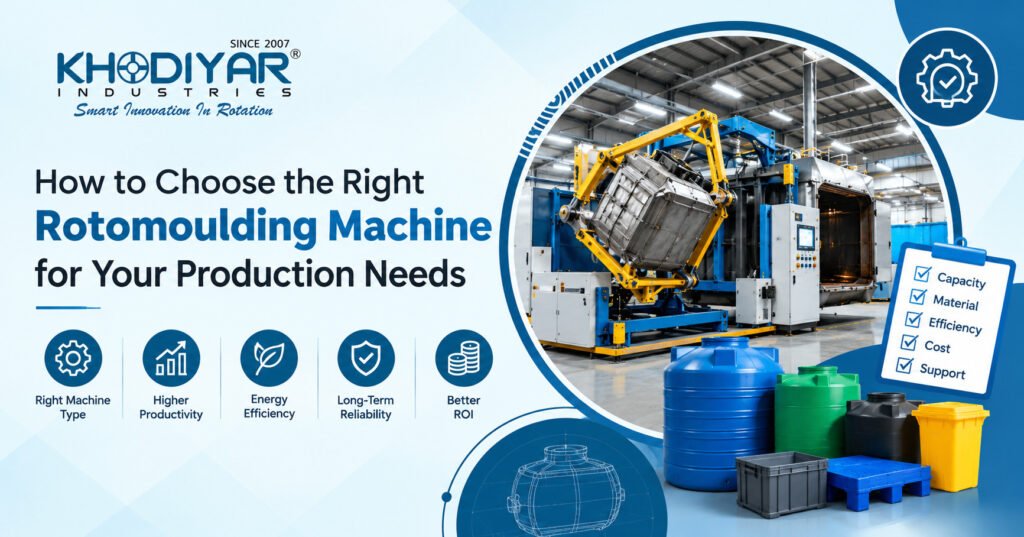
Rotational moulding, or rotomoulding, makes large, hollow, one-piece plastic products. The Institute of Polymer Technology at Friedrich-Alexander-Universität Erlangen-Nürnberg (FAU) describes it as a process capable of producing “seamless hollow structures with very low residual stresses”, in sizes up to more than 100,000 litres. Typical products include: In India, water storage tanks are among the most common rotomoulded products. The Bureau of Indian Standards covers them under IS 12701, “Rotational Moulded Polyethylene Water Storage Tanks”, which includes cylindrical vertical and rectangular loft tanks in single or multiple layers. Why the right machine matters for production efficiency The machine decides four things that shape your profit for years: Good rotomoulding machine selection balances all four against your budget, rather than optimising one and paying for it in the others. Understanding Rotomoulding Machines Definition and working principle A rotomoulding machine heats a hollow metal mould filled with plastic powder while rotating it, then cools it while it keeps turning. Every cycle has four steps: Because no pressure is used, the moulds are simpler and cheaper than those for injection or blow moulding, which is why rotomoulding suits large parts in moderate volumes. Types of rotomoulding machines available in the market The main machine types differ in how they rotate the mould and how they apply heat: The table below shows how these types compare in Khodiyar’s published specifications: Machine type Best suited to Size range in Khodiyar’s specifications Notes Single station bi-axial Round and symmetrical tanks; start-ups and mid-size plants Up to 2,000 L per mould (KI-2000 x 2) 6.5–13 HP; diesel or gas 3 and 4 arm bi-axial High-volume production of a varied product mix Up to 5,000 L per mould (KI-3/5000 and KI-4/5000) 19–48 HP; LPG, CNG or diesel burners; optional PLC Close oven rock n roll Long or large products, with heat contained in an insulated oven Up to 10,000 L (KI-10K) 7–14.5 HP; LPG; 20,000–60,000 L per 12 hours Open fire rock n roll Very large tanks and special products at low capital cost 200–40,000 L across models (KI-5K to KI-50K) 13–34 HP; LPG; needs a pit Key Factors in Rotomoulding Machine Selection The core machine selection factors are production capacity, material, size and footprint, energy and running costs, and automation. Fix these before you compare brands or prices. 1. Production capacity requirements Start with numbers, not models: Then compare against published output. On our single station bi-axial machines, for example, the rated production over 24 hours is 36,000 litres on the KI-1000 x 2, 64,000 litres on the KI-1000 x 4 and 70,000 litres on the KI-2000 x 2. Divide your monthly demand by your working days and shifts, and you can quickly see which class of machine you need. If your demand sits right at a machine’s limit, size up or plan for a second machine. Running flat out leaves no room for mould changes, maintenance or growth. Multi-arm machines raise output because the arms work in parallel: while one arm is in the oven, another cools and a third is unloaded and recharged. Consider stepping up from a single station when: 2. Material compatibility and processing capabilities Most rotomoulded products are made from polyethylene. FAU notes that polyethylene accounts for over 80% of the materials used in the process. LLDPE is the usual grade for tanks; HDPE suits stiffer parts; polypropylene, nylon and PVC are used for specific applications. Material affects choosing roto moulding machine features in three ways: 3. Machine size and footprint considerations Size the machine for your largest and longest product, not your average one, and then check that it fits your site. A machine that arrives before the shed is ready, or that does not fit under the roof, delays production by weeks. 4. Energy efficiency and operational costs Heating is the largest running cost in rotomoulding, so compare fuel use per cycle and the fuels available at your site: Then look at how the oven keeps heat in: Cooling matters too. Research at Queen’s University Belfast reports that its Rotocooler system “reduces cooling times for the rotomoulding process by up to 40% with production rate increase by up to 15%”. Faster, well-controlled cycles mean more parts from the same fuel. Always compare cost per litre of product, not just the price of the machine. A cheaper machine that burns more fuel per cycle can cost more within a few years. 5. Automation features and technology integration Rotomoulding machines range from simple manual operation to PLC-controlled automation: More automation is not automatically better. It pays where you run long batches of repeat products and where skilled operators are hard to retain. For a small range of products on one shift, a well-built semi-automatic machine may give a faster payback. How to Choose a Rotomoulding Machine: A Practical Guide Step-by-step guide to evaluating your needs Assessing your production process Before you buy, walk through your whole process, not just the machine: A machine should fit your process, not force you to rebuild everything around it. Analysing your budget and financial constraints Budget for the total cost of ownership: If capital is tight, a single station or open fire machine can get production started at a lower investment. You can then add a multi-arm machine as orders grow. Ask every supplier for rated fuel use, connected load and output, and calculate the cost per litre of product. Evaluating manufacturers Once you know which machine you need, compare who builds it: Common Mistakes to Avoid Overlooking production scalability Buying only for today’s product is the most common error. A machine that fits your 1,000-litre tank cannot make the 2,000-litre tank your next customer wants. Plan for the products you expect in three to five years, or choose a machine that can be expanded, such as a multi-arm machine with interchangeable arms. The opposite mistake also costs money: an oven far larger than you need runs half-empty and burns fuel on unused space. Size for realistic demand, with a margin, not for “just in case”.