


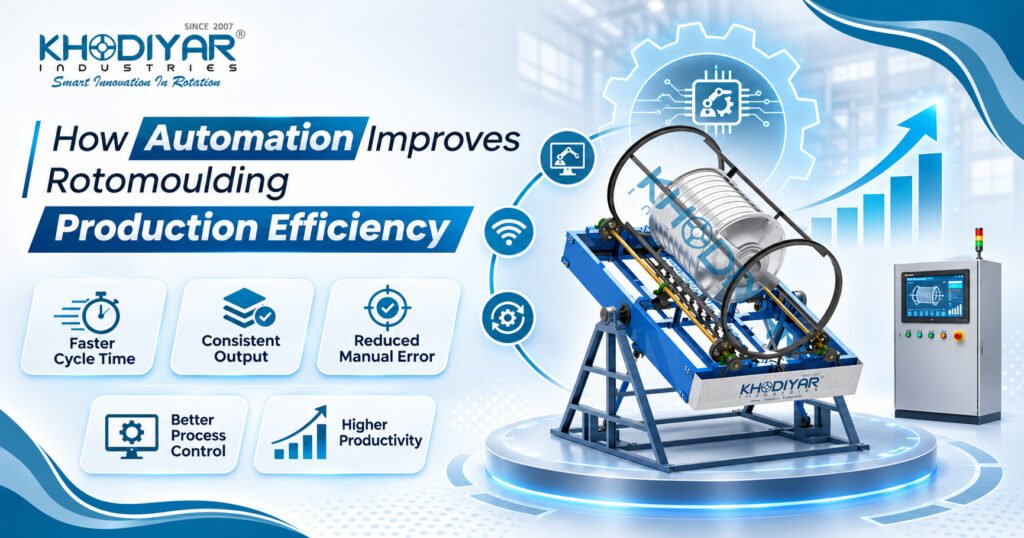
What is rotomoulding machine automation? Rotomoulding machine automation is the use of a programmable logic controller (PLC), operator touchscreen (HMI), temperature sensors, variable speed drives and, optionally, plant-wide monitoring (SCADA) to control the oven, arm rotation, cooling and indexing of a rotational moulding machine. Instead of operators judging time and temperature by experience, the machine runs each product from a stored recipe, records what happened and alarms when something drifts. The result is shorter, repeatable cycles, fewer rejects, lower fuel use per part and less dependence on individual operator skill.
- Automation improves rotomoulding production efficiency mainly through repeatable recipes, tighter temperature control and better-balanced cycles, not by replacing every operator.
- The biggest single gain usually comes from controlling heating by internal mould air temperature rather than by fixed time.
- A PLC controlled rotomoulding machine stores recipes, logs every cycle and interlocks burners, doors and arms for safety.
- Loading and demoulding remain largely manual on most machines; automation makes the rest of the cycle predictable.
- Retrofitting controls on an existing machine is often the lowest-cost first step.
Why Rotomoulding Production Efficiency Depends on Control
Rotational moulding is a slow, heat-driven process. A typical cycle loads powder, heats the mould in an oven while it rotates on two axes, cools it and demoulds the part. Heating and cooling can each take from several minutes to well over half an hour depending on wall thickness and part size.
On a manual or timer-based rotomoulding machine, the quality of each batch depends on the operator. Two operators running the same mould can produce different wall thicknesses, different cure levels and different cycle times. The common response is to add “a few extra minutes” of heating to be safe, which wastes fuel and can degrade the polymer.
Automation addresses this at the source. By measuring and controlling the process variables that decide quality and cycle time, a rotomoulding machine automated with modern controls produces more good parts per shift, with less fuel and fewer surprises.
This guide explains what rotational moulding automation includes, how it improves each stage of the cycle, what results are realistic and how to introduce it step by step. It is written for manufacturers, plant managers and buyers, drawing on the experience of Khodiyar Roto, an Ahmedabad-based manufacturer of rotomoulding machines since 2007.
What Rotational Moulding Automation Includes
Levels of automation
| Level | Typical features | Who it suits |
| Manual | Manual burner control, manual timing, operator judgement | Very low volumes, very large one-off parts |
| Semi-automatic | Digital timers, temperature controllers, automatic burner on/off | Small plants moving away from manual control |
| PLC controlled | PLC with HMI, stored recipes, automatic indexing, alarms and interlocks | Most regular production of tanks and containers |
| Closed-loop process control | PLC plus in-mould temperature measurement driving heating and cooling decisions | Plants focused on quality, energy and consistency |
| Connected (SCADA or MES) | Multiple machines monitored centrally, production and energy reports | Multi-machine plants and export-oriented manufacturers |
Core components of an automated rotomoulding machine
- PLC (programmable logic controller): the machine’s brain. It sequences the oven, cooling, rotation and indexing, and enforces safety interlocks. PLC software is commonly written to the IEC 61131-3 programming standard.
- HMI touchscreen: where operators select recipes, view live temperatures and times, and acknowledge alarms.
- Temperature sensors: thermocouples for oven air, and in more advanced systems wireless or slip-ring sensors that measure the air temperature inside the mould.
- Burner management system: controls ignition, flame monitoring and modulation safely. Industrial oven and burner safety is addressed in standards such as EN 746-2 and NFPA 86.
- Variable frequency drives (VFDs): set and hold the speed of the major and minor axes, and control fan speeds.
- Cooling controls: fans, water mist solenoids and timers switched by the PLC.
- Safety devices: door interlocks, emergency stops, light curtains or guards around moving arms. Machinery safety functions are commonly designed to ISO 13849-1.
- Data logging and SCADA: record cycle data and, in larger plants, connect several machines to a central monitoring system.
How Automation Improves Each Stage of the Rotomoulding Cycle
Oven heating
Heating is usually the longest and most energy-intensive stage. Automation improves it in three ways:
- Stable oven temperature. The PLC modulates burners to hold the set-point instead of cycling on and off, which reduces overshoot and fuel waste.
- Recipe-based heating. Each product has a stored oven temperature and time, so every batch starts from proven settings.
- Internal air temperature control. Research reviewed by Queen’s University Belfast identifies the air temperature inside the mould as the most effective parameter for controlling the process. Automated systems can end the heating stage when the internal air reaches the target peak temperature for the resin, rather than after a fixed time.
The third step is where many plants find their largest gain. It removes the “safety margin” of extra heating that operators often add, without risking under-cure.
Arm rotation
The ratio and speed of rotation on the two axes decide how evenly the powder coats the mould. VFD-controlled drives:
- Hold exact speeds batch after batch.
- Allow different ratios for different products, stored in the recipe.
- Can change speed during the cycle, for example slower during powder pick-up and different during melt consolidation.
Research reviewed by Queen’s University Belfast notes that varying rotational speed has been reported to shorten heating time by improving powder mixing and temperature uniformity.
Cooling
Cooling is often the bottleneck on multi-arm machines. Automation enables:
- Staged cooling: forced air first, then water mist switched on automatically at the right point.
- Consistent timing: each product cools for its proven duration, reducing warpage caused by inconsistent cooling.
- Internal cooling triggers: in advanced systems, internal cooling is started at a defined internal air temperature.
Rapid, symmetrical cooling is associated with finer polymer structure and less warpage, so controlled cooling can improve quality as well as speed.
Indexing, loading and demoulding
On multi-arm machines, the PLC moves arms between oven, cooling and loading stations. Automatic indexing:
- Prevents the oven door opening longer than needed.
- Holds an arm in the oven only for the required time.
- Alerts operators when a station is ready, so loading starts promptly.
Loading powder and demoulding parts remain manual on most production machines. Automation’s job here is to make waiting time visible and reduce it.
Key Benefits: Rotomoulding Cycle Time Reduction, Consistency and Cost
Rotomoulding cycle time reduction
Automation reduces cycle time by removing excess heating, balancing station times and cutting idle time at the oven. The size of the gain depends heavily on how the machine was run before.
Typical industry ranges, which should be confirmed on your own process:
- Heating time: the Robomould research platform at Queen’s University Belfast reduced heating time by about 22% compared with a convection oven for similar part quality (McCourt et al., 2017). That system uses direct electric heating, so results for conventional ovens with PLC control will differ.
- Overall cycle time: combined cycle-time measures studied at Queen’s University Belfast reduced overall cycle time by about 35% in an industrial case study, though that work combined several process changes rather than control alone.
Consistency and quality
- The same recipe runs every time, regardless of shift or operator.
- Wall thickness and cure level vary less between batches.
- Alarms catch deviations, such as a burner fault or slow oven recovery, before they create bad parts.
Waste and reject reduction
Rejected parts consume full material, fuel and machine time. Automation reduces common reject causes: under-cure (bubbles, low impact strength), over-cure (discolouration, brittleness) and warpage from inconsistent cooling. Rejected material can sometimes be reground, but with lost value.
Energy savings
Automation saves energy by avoiding over-heating, reducing burner cycling and shortening door-open time. Equipment suppliers claim energy savings from 30% to 70% for advanced machines compared with older convection ovens; these are vendor claims that combine heating technology and control, so measure your own fuel per good kilogram before and after any upgrade.
Labour productivity
Automation rarely eliminates operators, but it changes what they do. Instead of watching timers and adjusting burners, operators focus on loading, demoulding, inspection and housekeeping. One trained operator can often supervise more of the cycle, and new operators reach consistent results faster. Where experienced rotomoulding operators are hard to recruit and retain, stored recipes also protect the business when a skilled operator leaves.
Data and traceability
Every cycle can be logged: product, recipe, oven temperature, times and alarms. This supports root-cause analysis, customer audits and continuous improvement, and is increasingly expected by export customers. It also makes energy reporting and cost-per-part calculations straightforward.
Safety
Rotomoulding combines hot ovens, gas or diesel burners and heavy rotating arms. A PLC adds layers of protection that manual control can’t:
- Burners can’t ignite unless purge and flame-monitoring conditions are met.
- Arms can’t rotate or index while doors are open or guards are breached.
- Emergency stops bring every motion to a controlled halt.
- Alarms flag over-temperature, flame failure or drive faults immediately.
Fewer incidents also mean less unplanned downtime, which supports efficiency.
Predictive maintenance
Logged data reveals slow trends before they become breakdowns: an oven taking longer to recover set-point, a drive drawing more current, or a burner needing more cycles to ignite. Maintenance teams can plan repairs during scheduled stops instead of losing production to sudden failures.
Manual vs automated rotomoulding
| Factor | Manual or timer-based machine | Automated PLC controlled rotomoulding machine |
| Heating control | Fixed time, operator judgement | Stored recipes; optional internal air temperature control |
| Rotation | Fixed or manually set speeds | VFD-controlled, recipe-based ratios and speeds |
| Cooling | Manual switching of fans and water | Automatic staged cooling by recipe |
| Cycle consistency | Varies by operator and shift | Repeatable batch to batch |
| Reject rate | Higher and less predictable | Typically lower and easier to trace |
| Fuel per good kg | Higher due to over-heating and rejects | Lower, measurable per cycle |
| Operator skill needed | High process experience | Lower process judgement; more machine knowledge |
| Safety | Depends on procedures | PLC interlocks on doors, burners and arms |
| Data | Paper logs, if any | Automatic cycle logs, reports and alarms |
| Initial cost | Lower | Higher; retrofit options available |
Rotomoulding Process Optimization with Automation: How to Implement It
Step-by-step approach
- Measure your baseline. Record cycle times by stage, fuel use, reject rates and causes for at least two weeks.
- Standardise the process. Document current best settings for each product before automating them.
- Choose the right level. A PLC with HMI and recipes suits most tank manufacturers; closed-loop internal temperature control adds the most process insight.
- Retrofit or replace. Many existing machines can be upgraded with a PLC, HMI, VFDs and temperature sensors. Older machines with poor ovens or worn mechanics may justify a new machine.
- Build and validate recipes. Trial each product, check wall thickness, impact strength and appearance, and lock in the best settings.
- Train operators and maintenance staff. Automation only works if people trust and understand it.
- Monitor and improve. Use logged data to find further cycle time and energy gains each month.
This is rotomoulding process optimization in practice: measured, validated steps rather than a single large purchase.
Retrofit vs new automated machine
| Option | When it makes sense |
| Control retrofit (PLC, HMI, VFDs, sensors) | The machine’s oven, arms and structure are in good condition |
| New multi-arm automated machine | Output must increase significantly, or the existing oven is inefficient |
| New single station automated machine | Lower volumes, prototypes or very large parts that still need consistency |
Khodiyar Roto’s range includes 3 and 4 arm bi-axial machines for continuous production and single station bi-axial machines for lower volumes. [Khodiyar: confirm which automation levels, PLC brands, HMI features and data logging options are available on each model.]
Calculating payback
A simple payback estimate:
Payback (months) = automation investment ÷ monthly savings
Where monthly savings include fuel saved, material saved from fewer rejects, labour time redeployed and the margin on any extra output. Use your own measured baseline rather than headline percentages.
Limits of automation
Automation can’t fix every problem:
- Poor moulds, blocked vents or worn parting lines still cause defects.
- Inconsistent powder quality still causes bubbles and uneven walls.
- An inefficient, badly insulated oven still wastes heat, even with perfect control.
- Sensors, PLCs and drives need maintenance and skilled technicians.
The best results come when automation is combined with good moulds, consistent material and a well-maintained machine. Our guide on how to choose the right rotomoulding machine covers these wider factors.
What to Look for in an Automated Rotomoulding Machine
When comparing suppliers, ask specific questions rather than accepting “fully automatic” at face value:
- Controller and HMI: which PLC and HMI brands are used, and are spares and support available locally?
- Recipes: how many product recipes can be stored, and what parameters do they control (oven temperature, heating time, rotation speeds and ratio, cooling stages)?
- Temperature measurement: is oven air temperature measured at more than one point? Is in-mould internal air temperature measurement available or supported?
- Burner management: what flame safety and modulation features are included, and to which standard are they designed?
- Drives: are both axes driven by VFDs with recipe-controlled speeds?
- Cooling control: are fans and water mist stages automatic and programmable?
- Data: can cycle data be exported, and can the machine connect to SCADA or a plant monitoring system later?
- Safety: which interlocks, guards and emergency stops are fitted?
- Training and service: is commissioning, operator training and remote support included?
- Upgrade path: can features such as internal temperature control or SCADA be added later?
Clear answers to these questions separate genuine rotomoulding machine automation from basic timers on a control panel.
Conclusion
Rotational moulding automation improves production efficiency by making each cycle predictable: the right oven temperature, the right heating end-point, the right rotation and the right cooling, every time. The gains show up as rotomoulding cycle time reduction, fewer rejects, lower fuel per good kilogram and clearer production data.
Start with a measured baseline, automate the stages that vary most, validate every recipe and keep improving with the data you collect.
Considering automation for your plant? Contact Khodiyar Roto to discuss a PLC controlled rotomoulding machine or an upgrade for your existing line.
Frequently Asked Questions
It is the use of a PLC, touchscreen HMI, temperature sensors and variable speed drives to control oven temperature, heating time, arm rotation, cooling and indexing from stored recipes. It makes each cycle repeatable and records data for every batch.
It is a rotomoulding machine whose oven, burners, rotation, cooling and arm movements are sequenced by a programmable logic controller. Operators select a product recipe on the HMI, and the PLC runs the cycle, monitors temperatures and stops the machine safely if a fault occurs.
It removes excess heating by ending the oven stage at the right temperature, keeps oven temperature stable, automates staged cooling and indexes arms as soon as each station is ready. The gain depends on how consistently the machine was run before automation.
It reduces the time operators spend watching timers and adjusting burners, and makes results less dependent on individual skill. Loading powder and demoulding parts are still manual on most machines, so automation usually redeploys labour rather than removing it.
Yes. Stable burner control, avoiding over-heating and shorter door-open times all cut fuel use per good part. Measure fuel per kilogram before and after, because savings vary widely with the starting condition of the machine and oven.
Often, yes. If the oven, arms and structure are in good condition, a retrofit with a PLC, HMI, VFD drives and temperature sensors can bring most of the benefits of a new automated machine at lower cost.
It means measuring the air temperature inside the mould during the cycle and using it to decide when heating should end. Research identifies it as the most effective process control parameter, because it reflects what is happening to the polymer, not just the oven.
SCADA connects several machines to a central system that monitors status, collects cycle data, records alarms and produces production and energy reports. It is most useful in plants running multiple machines or supplying customers who require traceability.
Yes. Repeatable heating, rotation and cooling reduce variation in wall thickness and cure, and alarms catch faults before they create bad parts. Quality still depends on good moulds and consistent powder.
Divide the automation investment by the monthly savings from fuel, reduced rejects, redeployed labour and extra output. Use your own measured baseline rather than general percentages to get a realistic figure.