


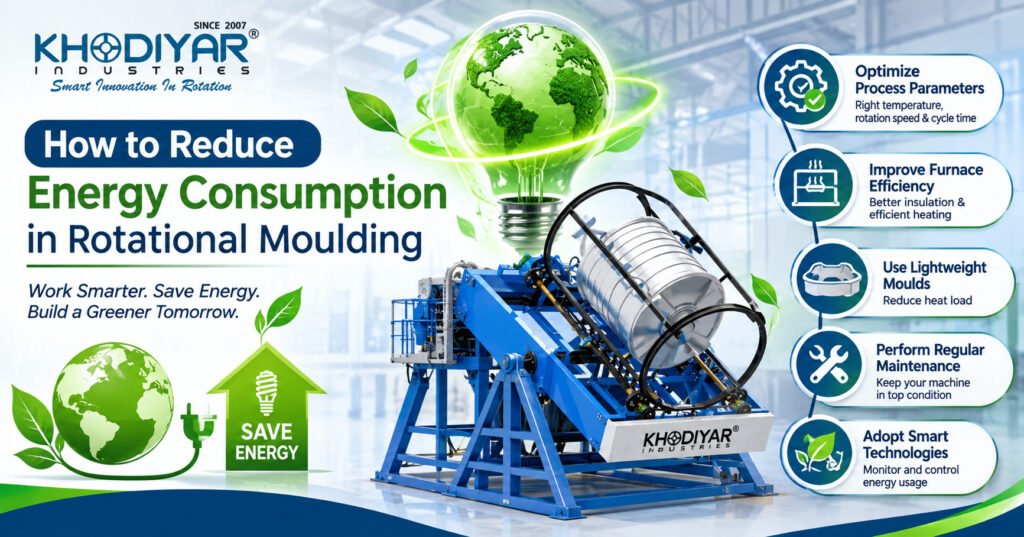
Most of the fuel burned in a conventional rotomoulding oven never reaches the plastic. A widely cited Queen’s University Belfast analysis found only about 8% of oven energy heats and melts the polymer, with the rest lost to combustion, the flue, wall gaps, door openings and heating the arm. The fastest way to reduce energy consumption in rotational moulding is therefore to cut those losses: tune burners, seal and insulate the oven, shorten heating with internal temperature control, and keep the oven fully loaded. Machine choice, mould materials and cooling strategy then lock in the savings.
Why Rotational Moulding Energy Efficiency Matters
The rotational moulding process is simple in principle: load powder into a mould, heat it while rotating on two axes, cool it, and demould. But heating a large steel or aluminium mould inside a hot oven for every cycle makes rotomoulding one of the more energy-intensive plastics processes per kilogram of product.
For tank and container manufacturers, fuel is often one of the largest running costs after raw material. Diesel, LPG or PNG prices move quickly, and every percentage point of wasted heat is paid for on every cycle, every shift.
Improving rotational moulding energy efficiency delivers three benefits at once:
- Lower cost per kilogram, because less fuel and electricity is used for each good part.
- Higher output, because shorter heating and cooling also shorten the cycle.
- More consistent quality, because controlled heating reduces over-cured and under-cured parts.
This guide sets out where the energy goes, how to measure it, and the practical measures that make the biggest difference, based on plant experience at Khodiyar Roto, an Ahmedabad manufacturer of rotomoulding machines and moulds since 2007.
Where the Energy Goes in the Rotational Moulding Process
The cycle stages and their energy demand
| Cycle stage | What happens | Energy demand |
| Loading | Powder charged, mould closed | Small: mainly lighting and handling |
| Heating | Mould and powder heated in the oven while rotating | Very high: burner fuel, oven fans, rotation drives |
| Cooling | Mould cooled with air and sometimes water | Moderate: cooling fans, pumps, rotation drives |
| Demoulding | Part removed, mould prepared | Small |
Heating dominates. For many polyethylene products, oven set-points of roughly 250 to 350 °C are common, depending on the part, mould and machine.
The heat balance of a conventional oven
The Queen’s University Belfast study, summarised by the Association of Rotational Molders, broke down where energy goes in a conventional gas-fired oven:
- About 8% heats and melts the polymer.
- About 7% heats the mould.
- About 25% is lost to incomplete combustion.
- About 24% goes up the flue.
- About 12% escapes through gaps in walls and roof.
- About 10% is lost when the door opens and closes.
- About 9% heats the arm and is lost during cooling.
- About 5% is lost through convection.
The study is several decades old, and modern machines are generally better, but the pattern still holds: most energy is lost before it reaches the mould. That is why burner, insulation and door improvements often pay back faster than any process change.
Measuring Rotational Moulding Energy Consumption
You can’t reduce what you don’t measure. Before investing, establish a baseline.
Key metrics
- Fuel per cycle: litres of diesel, kg of LPG or SCM of PNG per oven cycle.
- Fuel per good kilogram: total fuel ÷ kg of accepted parts. This is the most honest measure, because rejects consume full energy.
- Electrical energy per shift: kWh for oven fans, rotation drives, cooling fans and pumps.
- Rotomoulding machine power consumption: connected load and actual measured load for each motor.
How to collect the data
- Fit a fuel flow meter or log tank levels per shift.
- Install an energy meter on the machine’s main supply.
- Record cycle times by stage and the number of moulds per arm.
- Record reject rates and their causes.
- Run for at least two weeks across products and shifts.
Plants that do this usually find wide variation between shifts and products. That variation is the first opportunity.
Oven, Burner and Insulation Measures
Tune burners and combustion
Incomplete combustion was the largest single loss in the Belfast analysis. Practical steps:
- Service burners regularly: clean nozzles, filters and igniters.
- Set the air-fuel ratio with a flue gas analyser rather than by eye. Too little air wastes fuel as unburned hydrocarbons; too much air carries heat up the flue.
- Use modulating or high-low burners where possible, so the burner doesn’t run flat out once the oven is at set-point.
- Check fuel quality: contaminated diesel causes poor combustion and soot.
Improve oven insulation and sealing
- Inspect insulation panels for compression, gaps and moisture damage; replace damaged sections.
- Replace worn door seals and check door alignment.
- Seal gaps around arm openings and panel joints.
- Use a thermal camera to find hot spots on the oven skin, which show where heat escapes.
A well-insulated oven also recovers set-point faster after each door opening, which shortens the cycle.
Reduce door-open losses
- Prepare the next arm before the oven door opens.
- Minimise the time the door stays open during indexing.
- On multi-arm machines, balance station times so the oven isn’t opened more often than necessary.
Recover waste heat
Flue gas leaves the oven hot. Where practical, recovered heat can pre-heat combustion air or warm the plant in colder regions. This needs engineering assessment and is usually most viable on larger, continuously running ovens.
Rotational Moulding Cycle Time Optimization
Every minute removed from the heating stage saves fuel directly. Rotational moulding cycle time optimization is therefore an energy measure as much as a productivity one.
Control heating with internal air temperature
Many plants still heat by time alone and add “a few extra minutes to be safe”. That margin is wasted fuel.
- Use an internal air temperature data logger inside the mould to measure the peak internal air temperature (PIAT).
- For many polyethylene grades, the correct PIAT is in the region of 200 to 220 °C, but always confirm the target for your resin with the supplier.
- Set heating time to reach that target consistently, then stop.
Over-cooking wastes fuel and degrades the polymer; under-cooking leaves bubbles and low impact strength.
Balance oven temperature and time
Higher oven temperatures can shorten heating time. The Belfast research found oven temperature had the largest effect on cycle time, followed by oven fan capacity. But excessive temperature risks surface degradation, so increase it only with temperature monitoring and quality checks.
Optimise cooling
Cooling doesn’t burn fuel, but on a multi-arm machine a long cooling stage leaves the oven idling at temperature, which does.
- Staged cooling: forced air first, then controlled water mist once the part has started to set.
- Internal cooling: research at Queen’s University Belfast found air amplifiers the most effective internal cooling method tested, and combined cycle-time measures cut overall cycle time by about 45% in trials and about 35% in an industrial case study.
- Avoid over-aggressive early water cooling, which causes warpage.
Mould materials and design
| Mould material | Energy effect |
| Sheet steel | Durable and lower cost; slower to heat and cool because of higher mass |
| Cast aluminium | Higher thermal conductivity; heats and cools faster for the same part |
| Thin, well-supported aluminium or nickel shells | Fastest heat transfer, but higher tooling cost and suited to specific parts |
Other mould factors:
- Avoid unnecessary mould mass in frames and supports, which heat up every cycle.
- Keep vents clean so pressure doesn’t distort the part and force longer cycles.
- Maintain good mould surface condition for faster, cleaner release.
Materials
- Use consistent, well-ground powder (commonly around 35 mesh) with good dry flow and bulk density. Poor powder needs longer heating to remove bubbles.
- Keep powder dry and free of contamination.
- Choose grades suited to the product; a resin that sinters easily reduces the heat needed.
Machine Choice and Rotomoulding Machine Power Consumption
Choosing an energy efficient rotomoulding machine
An energy efficient rotomoulding machine is defined less by a single feature than by how well it keeps heat in and the oven busy.
- Multi-arm machines keep the oven heating continuously while other arms cool and load, so less heat is lost to idle time. Khodiyar’s 3 and 4 arm bi-axial machines are designed for this continuous use.
- Close oven rock and roll machines enclose long and large moulds, retaining heat far better than open-flame heating.
- Open fire rock and roll machines suit very large tanks but lose more heat to the surroundings, so burner control and shielding matter more.
- Good oven insulation, tight doors and correctly sized burners matter more than headline burner capacity.
See Khodiyar’s close oven rock and roll machine for an enclosed option for long products.
Load the oven fully
The Belfast study noted that heat use improves with more moulds per arm. Running a half-empty arm uses almost the same oven energy as a full one. Plan production so each arm carries the maximum safe mould load.
Electrical loads
Rotomoulding machine power consumption comes mainly from oven circulation fans, rotation drives, cooling fans and pumps.
- Fit variable frequency drives (VFDs) on fans and pumps. Fan power varies roughly with the cube of speed, so a 20% speed reduction cuts fan power by about half.
- Use high-efficiency motors (IE3 or better) when replacing motors.
- Switch off cooling fans and pumps when stations are idle.
- Maintain drives: worn gears, chains and bearings increase power draw.
Comparison of energy-saving measures
The figures below are indicative ranges based on the heat losses described above and general industrial energy experience. Actual results depend on your machine’s starting condition, so measure before and after.
| Measure | What it targets | Indicative saving | Indicative payback |
| Burner tuning and servicing | Incomplete combustion, excess air | Often 5–15% of fuel | Weeks to a few months |
| Door seals and insulation repair | Wall, roof and door losses | Often 5–10% of fuel | Months |
| Internal air temperature control | Over-cooking | Often 5–15% of heating fuel | Weeks to months |
| Full arm loading and scheduling | Idle oven energy | Varies widely with current utilisation | Immediate, low cost |
| Staged and internal cooling | Oven idle time on multi-arm machines | Indirect, via shorter cycles | Months |
| VFDs on fans and pumps | Electrical consumption | Often 20–50% of those motors’ power | 1–2 years |
| Aluminium moulds (at replacement) | Mould heating and cooling time | Shorter cycle per part | Over the mould’s life |
| Multi-arm or close-oven machine upgrade | Overall heat use and idle time | Significant; depends on old equipment | Several years; justify with output gains too |
How to Reduce Energy Consumption in Rotomoulding: Action Plan
Here’s a practical sequence for how to reduce energy consumption in rotomoulding, starting with the cheapest measures.
- Measure fuel and electricity per good kilogram for two weeks.
- Tune burners with a flue gas analyser.
- Repair seals and insulation, guided by a thermal camera survey.
- Introduce internal air temperature monitoring and cut excess heating time.
- Load arms fully and group products with similar heating needs.
- Optimise cooling to keep the oven from idling.
- Fit VFDs on large fans and pumps.
- Plan mould and machine upgrades based on measured savings and output.
- Review monthly and sustain the gains with operator training.
This is rotomoulding process optimization in practice: small, measured changes that cut energy without compromising product quality.
Conclusion
Most of the energy in a conventional rotomoulding oven is lost before it reaches the plastic. That makes rotational moulding energy consumption one of the most improvable costs in a plant.
Start by measuring fuel per good kilogram. Tune burners, seal and insulate the oven, and use internal temperature monitoring to stop over-heating. Then balance cooling, load arms fully, fit VFDs and plan mould and machine upgrades around measured results.
The outcome is lower cost per part, shorter cycles and more consistent quality, from the same plant.
Frequently Asked Questions
Each cycle heats a large mould, its frame and the oven air to well above the polymer’s melting point, then cools everything down again. Studies of conventional gas ovens found only around 8% of the energy reached the polymer, with most lost to combustion inefficiency, the flue, gaps and door openings.
Tuning burners and repairing oven seals and insulation usually give the quickest return. Both target the largest heat losses, need limited investment, and can often be done during planned maintenance. Combine them with internal temperature monitoring to stop over-heating parts.
Heating time drives fuel use directly, so every minute removed from the oven stage saves fuel. On multi-arm machines, long cooling or loading stages leave the oven idling at temperature, so balancing all stations reduces energy per part as well as increasing output.
Aluminium conducts heat better than steel, so the mould and powder usually heat and cool faster, shortening the cycle and reducing fuel per part. Aluminium moulds typically cost more to make, so the case is strongest for high-volume products or when a steel mould needs replacing.
Generally, yes. A multi-arm machine keeps the oven working while other arms cool and load, so less heat is lost to idle time between cycles. The benefit depends on balanced station times and loading each arm with as many moulds as it can safely carry.
Electric heating avoids combustion and flue losses, and induction heating is claimed to be around 90% efficient. Whether it lowers cost depends on local electricity versus fuel prices, the grid’s reliability and the investment needed. For most Indian plants, improving existing fuel-fired ovens is the first step.
Signs include yellowing or discolouration, a strong odour, a degraded or discoloured inner surface, brittle walls and poor impact results. The most reliable check is measuring the peak internal air temperature with a data logger and comparing it with the resin supplier’s recommended range for that grade.
It shouldn’t, if changes are controlled and measured. Removing excess heating time with temperature data often improves quality by preventing polymer degradation. Change one variable at a time, and validate every change with wall thickness, impact and visual checks before adopting it as the standard recipe.