


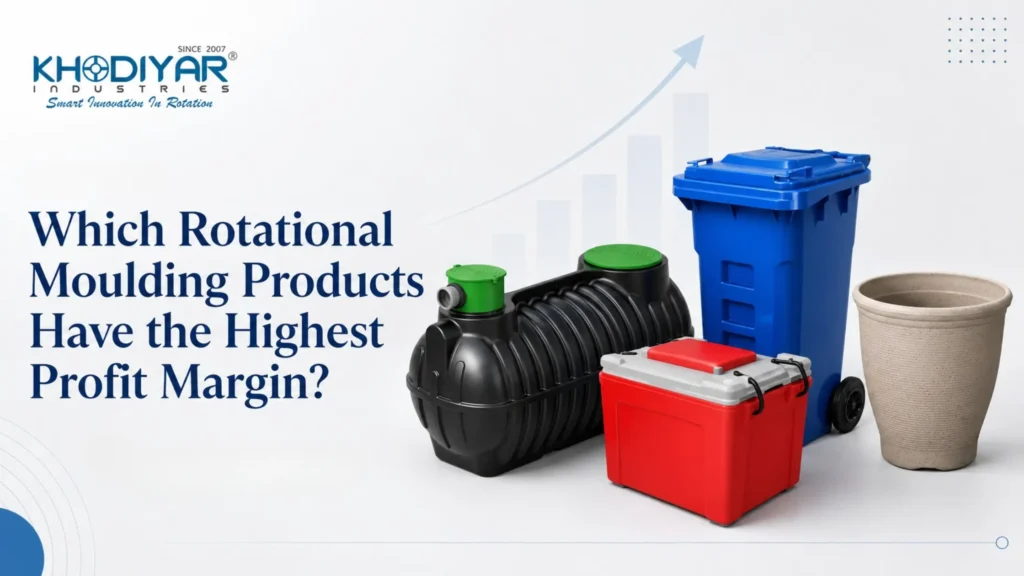
Custom OEM parts, material handling items such as pallets and crates, and road safety products generally carry the highest margins in rotational moulding. Commodity water tanks carry the lowest, despite being the highest volume. Margin is decided less by the product itself than by resin cost share, cycle time, freight radius and how commoditised the segment is.
Almost every new rotomoulder in India starts with water tanks. Demand is predictable, the process is well understood, and the market is easy to enter. That last point is exactly the problem: a market that is easy to enter is a market where nobody earns much.
This article compares margin potential across the products commonly made by rotational moulding, explains the five factors that actually determine profitability, and gives you a simple method to compare any two products before you invest in tooling.
Why Water Tanks Are the Highest Volume but the Lowest Margin
Water tanks are the entry product for good reason – but they sit at the bottom of the margin table, and it is worth understanding why before building a business around them.
• The product is fully commoditised. A 1,000 litre triple-layer tank is broadly the same wherever it is made. When buyers cannot see a difference, they buy on price.
• Prices are transparent. Rates are widely known across dealers and end customers, which caps what you can charge regardless of your cost base.
• Resin dominates the cost. For a commodity tank, material is usually well over half the selling price. That leaves very little room to absorb a price cut.
• Freight limits your market. A tank is mostly enclosed air. Beyond a few hundred kilometres, transport cost makes you uncompetitive against a local manufacturer.
• Cycle times are long. Large tanks occupy the oven for a long time, which reduces how much value the plant produces per hour.
None of this makes tanks a bad product. Volume is genuinely useful – it builds cash flow, keeps the plant loaded and teaches you the process. Many established plants run dedicated tank production lines as a stable base and add higher-margin work alongside. The mistake is assuming tanks alone will produce a strong return.
The Five Factors That Actually Decide Margin
Margin in rotational moulding is not really a property of the product. It is a property of these five variables, and any product can be moved up or down the table by changing them.
1. Resin cost as a share of selling price. The lower this share, the more room you have. Technical and design-led products sell at a multiple of their material cost; commodity products sell at a small premium over it.
2. Cycle time. Your oven is the bottleneck of the entire plant. A product that takes 25 minutes generates more than twice the output of one that takes 55 minutes, using the same energy and labour.
3. Mould cost and amortisation. An expensive mould is irrelevant across 50,000 parts and fatal across 500. Always divide tooling cost by realistic lifetime volume, not by your first order.
4. Freight-to-value ratio. Rotomoulded goods fill a truck by volume long before they reach its weight limit. High-value, compact products travel profitably; bulky low-value products do not.
5. Competitive intensity. How many manufacturers within your freight radius make the same thing? This single question explains most of the margin difference between tanks and custom parts.
Rotational Moulding Products Ranked by Margin Potential
The ranking below reflects relative margin potential in the Indian market, not guaranteed figures. Your own position will depend on scale, location, resin buying power and how much of the process you control in-house.
| Product | Margin Potential | What Drives It | Main Constraint |
| Custom / OEM moulded parts | Highest | Client-specific tooling, no direct price comparison, contracted volumes | Needs design capability and a reliable client base |
| Material handling – pallets, crates, bins | High | Short cycle times, industrial buyers, repeat orders | Competes with injection moulding and wood |
| Road safety – barriers, cones, delineators | High | Government and contractor demand, specification-led buying | Tender cycles, delayed payments |
| Playground equipment | High | Design-led, low price transparency, sold as a system | Long sales cycle, safety compliance |
| Insulated products – ice boxes, cold chain | Medium to High | Technical value-add, foam filling, fewer competitors | Higher process complexity |
| Underground and septic tanks | Medium | Fewer manufacturers, structural requirement | Large moulds, long cycle times |
| Dustbins and waste bins | Medium | Municipal tenders, steady volumes | Heavy price competition on standard sizes |
| Milk cans and food containers | Medium | Food-grade requirement narrows the field | Certification and resin cost |
| Flower pots and planters | Low to Medium | Very short cycle times, high output per shift | Low unit value, freight-sensitive |
| Water storage tanks | Lowest | High volume and steady cash flow | Fully commoditised, price-transparent, freight-limited |
The Highest-Margin Segments, Explained
1. Custom and OEM moulded parts
This is consistently the strongest margin category. When you mould a part to a client’s own drawing – a machine housing, an agricultural component, a tank for an equipment builder – there is no competing product for the buyer to price-compare against. Orders are contracted, volumes are predictable, and the client carries part of the tooling cost. The barrier is capability: you need design support and the reputation to win that first contract.
2. Material handling – pallets, crates and industrial bins
Pallets and crates have two structural advantages: short cycle times and industrial buyers who purchase repeatedly. A pallet that clears the oven in 25 minutes produces far more contribution per hour than a tank occupying it for an hour. Buyers are businesses evaluating total cost of ownership against wooden pallets, not consumers shopping on sticker price.
3. Road safety products
Barriers, traffic cones and delineators are bought against a specification by municipalities, highway contractors and infrastructure companies. Specification-led buying is far less price-sensitive than open-market retail. The trade-off is the tender cycle – qualification takes time and payment terms are often long – so this suits a business with working capital already in place.
4. Playground and recreational equipment
Playground items are sold as designed systems rather than as commodity mouldings, often bundled with installation. Buyers compare on design, safety compliance and durability, which leaves genuine room on price. Tooling is more complex and the sales cycle is longer, but competition within any given region is usually thin.
5. Insulated and cold-chain products
Ice boxes and insulated containers involve a second process step – foam filling – which immediately narrows the field of competitors. Every additional process step you can perform reliably is a margin opportunity, because it moves you further from pure commodity moulding.
The Metric That Actually Matters: Contribution Per Oven Hour
Most rotomoulders compare products on margin percentage. That is the wrong measure, because it ignores the constraint that limits the whole plant – oven time.
| The calculation: Contribution per oven hour = (Selling price − Variable cost) ÷ Cycle time in hours. Variable cost means resin, power, labour and consumables – the costs that change with each part produced. |
Here is why it changes the answer. The figures below are illustrative – substitute your own costing – but the pattern holds across most plants.
| Metric | Water Tank (1,000 L) | Industrial Pallet |
| Selling price | ₹6,000 | ₹2,400 |
| Variable cost (resin, power, labour) | ₹4,500 | ₹1,500 |
| Contribution per part | ₹1,500 | ₹900 |
| Margin on selling price | 25% | 37.5% |
| Cycle time | 55 minutes | 25 minutes |
| Parts per oven hour | 1.09 | 2.40 |
| Contribution per oven hour | ₹1,640 | ₹2,160 |
The tank sells for two and a half times the price of the pallet and returns ₹1,500 per part against ₹900. On per-part contribution it wins comfortably. But the pallet clears the oven in less than half the time, so it produces roughly a third more value per oven hour – and it does so using the same energy, the same operator and the same floor space.
This is why plants running short-cycle products often out-earn plants running large tanks, and why machines with multiple arms change the economics so sharply. More arms means more parts through the same oven in the same hour.
How to Improve Margin on Any Rotomoulded Product
Before switching products, it is usually worth checking how much margin is available inside the products you already run.
• Cut cycle time. Better mould heat transfer, correct oven loading and accurate temperature control all shorten cycles. Every minute saved is capacity created at zero capital cost.
• Reduce wall thickness variation. Most rotomoulders overcharge powder so the thinnest point still meets specification. Tighter control means less resin per part, and resin is your biggest variable cost.
• Bring powder production in-house. Buying granules and grinding them yourself removes a conversion margin you are currently paying someone else.
• Compound your own material. Mixing your own colour and additive blend costs less than buying ready compound, and gives you control over quality and lead time.
• Reprocess scrap properly. Rejected parts and flash still have material value. Recovering them systematically cuts effective resin cost per part.
• Move up the value chain. Fitting, assembly, foam filling, printing and branded packaging all add margin that pure moulding cannot.
The in-house material route is usually the fastest payback of these. A grinding setup for converting granules to powder, a unit for blending your own compound and a system for recovering rejected parts together attack the single largest line in your cost sheet.
Key Takeaways
• Custom OEM parts carry the highest margins because they cannot be directly price-compared
• Water tanks are the highest-volume product but the lowest-margin one, due to commoditisation and freight limits
• Contribution per oven hour, not margin percentage, is the correct metric for comparing products
• Short-cycle products such as pallets often out-earn large tanks despite a lower price per part
• Resin is typically the largest variable cost, so in-house grinding and compounding directly improve margin
• Freight radius effectively defines your market – bulky low-value products cannot travel far profitably
• Every additional process step you control moves you further from commodity pricing
Frequently Asked Questions
1. Which rotational moulding product has the highest profit margin?
Custom and OEM moulded parts generally carry the highest margins, because they are made to a client specification and cannot be price-compared directly against a competitor. Among standard products, material handling items such as pallets and crates, and road safety products, usually deliver the strongest margins.
2. Are water tanks profitable to manufacture?
Water tanks are profitable on volume rather than on margin. They are fully commoditised, prices are transparent across the market, and freight limits your selling radius. They generate steady cash flow and are a reasonable entry product, but they rarely produce the best return per oven hour.
3. Why is cycle time so important to rotomoulding profit?
Your oven is the bottleneck of the whole plant. Two products can show the same margin percentage, but the one with the shorter cycle time produces more parts per hour and therefore earns far more per oven hour. Contribution per oven hour is the metric that actually matters.
4. How much does resin cost affect rotomoulding margins?
Resin is usually the single largest variable cost, often well over half of the total for commodity items. That is why any reduction in wall thickness variation, scrap rate or powder wastage translates directly into margin, and why in-house compounding and grinding are worth evaluating.
5. Does freight really affect rotomoulding profitability?
Significantly. Rotomoulded products are mostly enclosed air, so a truck fills by volume long before it reaches its weight limit. Freight per unit rises quickly with distance, which is why most rotomoulders serve a regional market and why bulky low-value items rarely travel far profitably.