


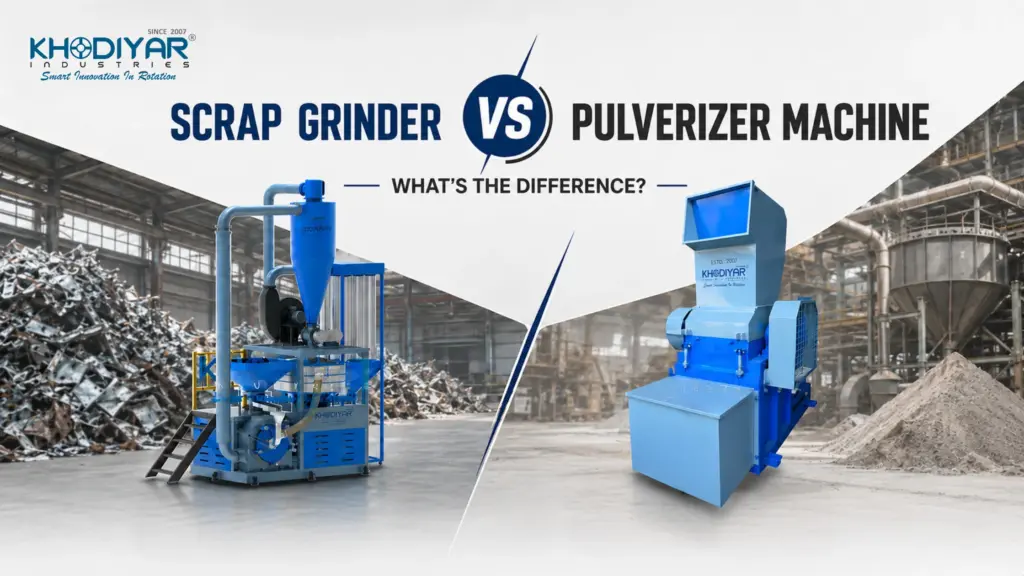
If you handle recycling, waste processing, or raw-material recovery, choosing between a scrap grinder vs pulverizer machine is one of the most important equipment decisions you will make. Both machines reduce material size, but they do it differently, produce different output, and suit different jobs. Pick the wrong one and you either over-process your material or fail to reach the particle size your process needs.
This guide breaks down the real difference between a scrap grinder machine and a pulverizer machine – how each works, where each fits, what output size to expect, and how to choose based on your material, volume, and budget. It is written for the people who actually make this call: engineers, plant managers, procurement teams, and factory owners.
What Is a Scrap Grinder Machine?
A scrap grinder machine is an industrial size-reduction machine that uses rotating blades to cut, shear, and grind bulky scrap – plastic, rubber, metal, or wood – into smaller, uniform granules or flakes, usually in the millimetre range.
A scrap grinding machine is built for the first stage of size reduction. It takes large, irregular scrap and turns it into a coarse, consistent granulate that is easier to store, feed, transport, or recycle. Output particle size is typically controlled by a screen mounted below the cutting chamber.
Because grinders rely on cutting action, they handle tough, stringy, and elastic materials well – the kind of feed that would clog or bounce out of finer machines. This makes the scrap grinder a workhorse in plastic recycling, where it is often called a granulator.
What Is a Pulverizer Machine?
A pulverizer machine is an industrial machine that reduces material into a fine powder using impact, attrition, or crushing forces – producing particle sizes measured in microns or mesh rather than millimetres.
An industrial pulverizer machine takes size reduction to the next level. Where a grinder stops at granules, a pulverizer keeps going until the material becomes a fine, free-flowing powder. It typically uses high-speed impact (hammers, pins, or discs) combined with air classification to control fineness.
Pulverizers are common wherever a fine, uniform powder is required – PVC and rotomoulding powders, minerals, spices, chemicals, and pulverizer machine for scrap applications like reprocessing plastic regrind into powder for compounding.
Scrap Grinder vs Pulverizer Machine: Key Differences
Here is the core comparison at a glance. Use it as your quick reference before reading the detail below.
| Factor | Scrap Grinder Machine | Pulverizer Machine |
| Primary action | Cutting / shearing with blades | Impact / attrition / crushing |
| Output size | Granules / flakes (mm range) | Fine powder (microns / mesh) |
| Stage of process | Primary / coarse reduction | Secondary / fine reduction |
| Best feed material | Bulky plastic, rubber, wood, light metal scrap | Pre-sized regrind, brittle solids, minerals, PVC |
| Typical output use | Recycling regrind, easier transport | Compounding, moulding powder, additives |
| Heat generation | Low to moderate | Higher (may need cooling) |
| Throughput vs fineness | High volume, coarser | Lower volume, much finer |
| Wear parts | Blades / knives, screen | Hammers / pins / discs, liners, screen |
Key takeaway: a scrap grinder makes material smaller; a pulverizer makes it finer. In many plants they work in sequence – grind first, then pulverize.
How Does a Scrap Grinder Work?
Understanding the working process helps you match the machine to your feed. A scrap grinder follows a simple, robust cycle:
1. Feeding: Scrap is loaded into a hopper, manually or via conveyor.
2. Cutting: a rotor fitted with rotating blades passes close to fixed bed knives, shearing the material.
3. Screening: a perforated screen under the chamber holds material until it is small enough to pass through, controlling output size.
4. Discharge: granules exit below the screen and are collected or blown to the next stage.
Change the screen and you change the output granule size – one of the simplest ways to tune a scrap grinding machine to your process.
How Does a Pulverizer Machine Work?
A pulverizer works on force and speed rather than a clean cut:
5. Feeding: pre-sized material enters the grinding chamber at a controlled rate.
6. Impact/attrition: high-speed hammers, pins, or discs strike and rub the material, fracturing it into fine particles.
7. Classification: air flow or a classifier separates fine powder from oversized particles, returning the coarse fraction for further reduction.
8. Collection: fine powder is captured in a cyclone or bag filter.
Because impact generates heat, many pulverizers include water or air cooling to protect heat-sensitive materials like plastics.
Types of Scrap Grinders and Pulverizers
Common Scrap Grinder Types
• Plastic scrap grinder / granulator: for runners, sprues, sheets, and rejected mouldings.
• Heavy-duty grinder: for rubber, tyres, and thick sections.
• Metal scrap grinder: for light metal turnings and offcuts.
Common Pulverizer Types
• Disc/pin pulverizer: for PVC and rotomoulding powders.
• Hammer mill: versatile impact pulverizer for brittle solids and minerals.
• Air classifier mill: for tightly controlled, ultra-fine particle size.
Industrial Applications
Both machines appear across recycling and manufacturing, but in different roles.
| Industry | Scrap Grinder Role | Pulverizer Role |
| Plastic recycling | Grind reject parts into regrind | Convert regrind to powder for compounding |
| Rubber / tyre | Reduce to crumb | Fine rubber powder for additives |
| Rotomoulding | — | Produce fine PVC / PE powder |
| Chemicals & minerals | — | Micron-level powder production |
| Metal processing | Reduce light scrap for remelting | Powder for metallurgy / coatings |
Benefits of Each Machine
Benefits of a Scrap Grinder Machine
• High throughput for bulky, mixed scrap.
• Simple, rugged design with low running cost.
• Easy output tuning by changing the screen.
• Turns waste into sellable, recyclable regrind – direct ROI.
Benefits of a Pulverizer Machine
• Produces fine, uniform powder that grinders cannot reach.
• Enables higher-value end products (compounds, coatings, moulding powder).
• Tight particle-size control with classification.
• Essential for processes that require micron-level fineness.
Key Features to Compare Before Buying
When you evaluate machines from any pulverizer machine manufacturer or grinder supplier, compare these features on a like-for-like basis:
• Output particle size: mm for grinders, microns/mesh for pulverizers.
• Throughput (kg/hr): matched to your daily volume, not peak marketing figures.
• Motor power (HP/kW): and energy consumption per tonne.
• Wear-part cost and availability: blades, hammers, screens, and liners.
• Cooling and dust control: critical for heat-sensitive or fine materials.
• Build quality and safety features – interlocks, guarding, and easy maintenance access.
Buyer Decision Factors: Which One Do You Actually Need?
Use this simple logic to shortlist the right machine:
• Need granules or flakes for recycling? → Scrap grinder machine.
• Need fine powder for compounding or moulding? → Pulverizer machine.
• Handling bulky, mixed, or tough scrap? → Start with a grinder.
• Already have regrind and need it finer? → Add a pulverizer.
• Need both stages? → A grinder + pulverizer line is common and cost-effective at scale.
Technical Considerations
A few technical points decide long-term performance:
• Material behaviour – elastic materials cut better (grinder); brittle materials shatter better (pulverizer).
• Heat sensitivity – plastics can soften or degrade; specify cooling where needed.
• Contamination control – metal detection and cleaning stations protect blades and product quality.
• Noise and dust compliance – align with workplace safety and emission norms.
Maintenance Tips to Protect Your Investment
9. Inspect and sharpen or replace blades, hammers, and screens on schedule – dull parts waste energy and reduce output quality.
10. Keep bearings lubricated and check belt tension regularly.
11. Clean the chamber between material changes to avoid cross-contamination.
12. Monitor motor load and vibration to catch problems early.
13. Stock critical wear parts to avoid unplanned downtime.
Industry Trends in Size-Reduction Equipment
The recycling and processing sector is moving quickly, and equipment is following:
• Energy efficiency – lower kWh per tonne as energy costs rise.
• Automation & IoT – sensors for load, temperature, and predictive maintenance.
• Circular economy demand – stronger push to recover and reuse plastic and rubber scrap.
• Finer, higher-value output – growing use of pulverized regrind in premium applications.
ROI and Long-Term Value
The right machine pays for itself in three ways: it turns waste disposal cost into recoverable material, reduces transport volume, and can create a sellable product from scrap. A scrap grinder machine delivers fast ROI on volume recycling, while a pulverizer machine unlocks higher margins by producing premium powder. When you compare scrap grinder price against a pulverizer investment, weigh not just the sticker cost but energy use, wear-part cost, and the value of the output you can sell.
Why Choosing the Right Machine Matters
Matching the machine to your material and target output size is the single biggest driver of efficiency, product quality, and profit in a size-reduction line. A grinder and a pulverizer are not competitors – they are different tools for different jobs, and understanding the difference between grinder and pulverizer ensures you invest in exactly what your process needs.
FAQs
1. What is the main difference between a scrap grinder and a pulverizer machine?
A scrap grinder machine cuts material into granules or flakes in the millimetre range, while a pulverizer machine reduces material into a fine powder measured in microns or mesh. In short, a grinder makes material smaller and a pulverizer makes it finer.
2. Can a pulverizer machine process scrap directly?
A pulverizer works best on pre-sized material. Bulky scrap is usually reduced first in a scrap grinder, and the resulting regrind is then fed into the pulverizer machine for scrap to achieve a fine powder.
3. Which machine is better for plastic recycling?
For most plastic recycling, a scrap grinder (granulator) is the primary machine because it turns reject parts into reusable regrind. A pulverizer is added when a fine powder is needed for compounding or rotomoulding.
4. What affects scrap grinder price and pulverizer cost?
Price depends on throughput, motor power, build quality, output fineness, wear-part cost, and optional features like cooling and automation. Always compare energy use and running cost, not just the purchase price.
5. Do I need both a grinder and a pulverizer?
If your process requires both granules and fine powder, a combined grinder-plus-pulverizer line is common and cost-effective. If you only need one output size, a single machine is enough.