

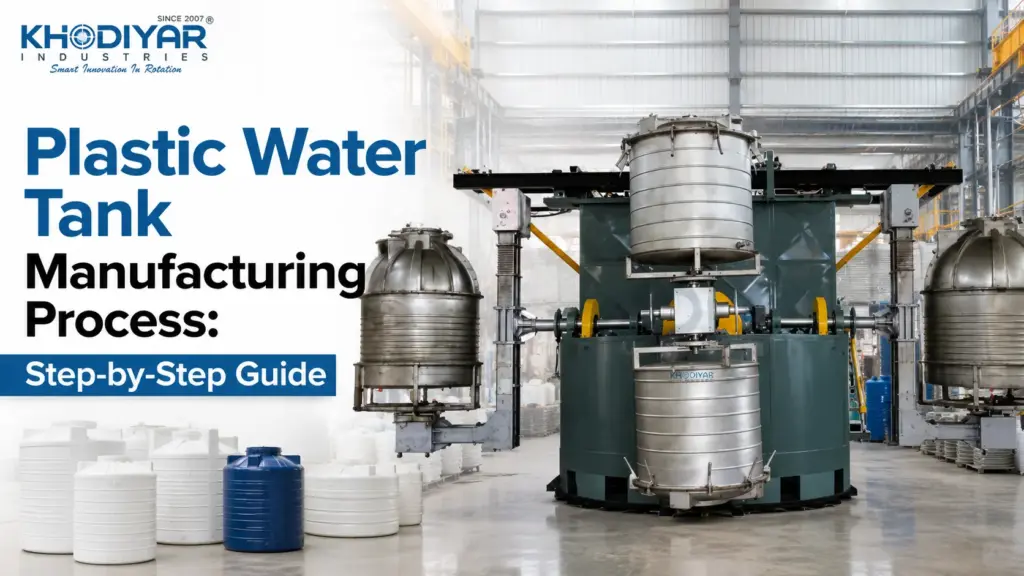
The plastic water tank manufacturing process uses a rotational moulding machine to turn LLDPE plastic powder into a seamless, leak-proof water tank. In simple terms, fine LLDPE powder is loaded into a hollow tank mould, and this plastic water tank making machine heats and rotates that mould on two axes so the melted plastic evenly coats the inside. After cooling, a single, joint-free tank is removed. The machine, the mould, and the powder quality together decide how strong and durable the finished tank is.
This step-by-step guide explains how plastic water tanks are made, which machines and equipment are used at each stage, the types of rotomoulding machines available, and the quality standards that define a good tank – a practical overview for anyone planning to start or scale a water tank manufacturing unit.
Which Machines Are Needed to Manufacture Plastic Water Tanks?
Setting up water tank production requires a small set of core machines. Each one handles a specific stage of the process:
• Pulverizer machine: Grinds LLDPE granules into a fine, uniform powder – the correct powder size is essential for even melting and smooth tank walls.
• Rotational moulding machine: The heart of the process. It heats and rotates the mould on two axes so the plastic forms a seamless tank. Available as bi-axial (3-arm, 4-arm, single station) and rock & roll types.
• Tank moulds: Hollow metal moulds in the tank’s shape – vertical, horizontal, slimline, or septic tank designs. The mould defines the tank’s size and shape.
• Scrap grinder: Recycles trimmed edges and rejected material back into reusable powder, cutting waste and raw-material cost.
Together, these machines form a complete rotomoulding production line capable of manufacturing water tanks, septic tanks, dustbins, pallets, and other moulded products.
What Raw Material Is Used?
The main raw material is food-grade LLDPE (Linear Low-Density Polyethylene), chosen because it is non-toxic, impact-resistant, and safe for drinking-water storage. UV stabilisers are added to resist sun damage, and colour masterbatch gives the tank its colour and blocks light. For premium multi-layer tanks, different materials are layered to add strength, insulation, and an anti-microbial inner surface.
How Plastic Water Tanks Are Made: Step-by-Step Process
Here is the complete rotational moulding process, with the machine used at each stage:
Types of Rotational Moulding Machines
Different rotomoulding machines suit different production needs. The right choice depends on tank size, output volume, and budget:
| Machine Type | Best For | Key Feature |
| Bi-axial 3-arm / 4-arm | High-volume tank production | Multiple moulds run together for higher output |
| Single station bi-axial | Small units & startups | Compact, lower cost, easy to operate |
| Close oven rock & roll | Large / long tanks | Even heating for big moulds |
| Open fire rock & roll | Economical large tanks | Direct-flame heating, budget-friendly |
Equipment Checklist to Start a Water Tank Manufacturing Unit
• A rotational moulding machine matched to your target tank sizes and output.
• A pulverizer to produce fine, uniform LLDPE powder in-house.
• Tank moulds in the shapes and capacities you plan to sell.
• A scrap grinder to recycle waste and reduce material cost.
• Food-grade LLDPE, UV stabilisers, and colour masterbatch as raw materials.
Quality Standards for Plastic Water Tanks
A quality tank depends on both the machine and the process control. In India, rotationally moulded polyethylene water storage tanks are certified to BIS standard IS 12701, which covers material grade, wall thickness, capacity, and safety. Key quality checks include:
• Uniform wall thickness across the tank – controlled by even rotation and heating.
• Correct weight and capacity for the rated tank size.
• Leak-proof, seamless body with no joints or weak points.
• Food-grade, UV-stabilised material for safe, long-lasting storage.
Why the Right Rotomoulding Machine Matters
Since the machine heats, rotates, and cools every tank, its precision directly shapes product quality, output speed, and running cost. A well-built rotational moulding machine delivers consistent wall thickness, faster cycles, lower rejection, and reliable output batch after batch – which is exactly what makes a tank manufacturing business profitable.
Khodiyar Industries, an Ahmedabad-based rotomoulding machine manufacturer with over 20 years of experience, designs bi-axial and rock & roll machines, pulverizers, scrap grinders, and tank moulds for manufacturers across India and export markets. Choosing an experienced machine partner ensures your production line is efficient, durable, and built for long-term output.
Conclusion
The plastic water tank manufacturing process relies on rotational moulding – a proven method where a rotomoulding machine turns food-grade LLDPE powder into a seamless, leak-proof tank through seven controlled stages. The quality of the finished tank depends heavily on the machines behind it: a good pulverizer for fine powder, a precise rotational moulding machine for even walls, the right moulds, and a scrap grinder to control cost. For anyone planning to manufacture water tanks, investing in reliable rotomoulding machinery is the foundation of a successful, high-quality production line.
Frequently Asked Questions
1. How are plastic water tanks manufactured?
Plastic water tanks are manufactured by rotational moulding. LLDPE powder is loaded into a tank mould, and a rotomoulding machine heats and rotates it on two axes so the melted plastic coats the mould evenly. After cooling, a seamless, one-piece tank is removed, finished, and quality-tested.
2. Which machine is used to make plastic water tanks?
A rotational moulding (rotomoulding) machine is used to make plastic water tanks, supported by a pulverizer to prepare LLDPE powder, tank moulds to shape the tank, and a scrap grinder to recycle waste. Bi-axial and rock & roll machines are the common types.
3. What is a rotomoulding machine?
A rotomoulding machine is equipment that heats a mould filled with plastic powder while rotating it on two axes. This coats the mould walls evenly and forms seamless hollow products such as water tanks, septic tanks, and dustbins.
4. What material is used to manufacture plastic water tanks?
Plastic water tanks are made from food-grade LLDPE (Linear Low-Density Polyethylene) with UV stabilisers and colour masterbatch added. Multi-layer tanks use additional layers for strength, insulation, and an anti-microbial inner surface.
5. What machines do I need to start a water tank manufacturing business?
To start water tank manufacturing you need a rotational moulding machine, a pulverizer for powder preparation, tank moulds in your chosen sizes, and a scrap grinder to recycle material. Food-grade LLDPE and UV stabilisers are the main raw materials.
6. Which standard applies to plastic water tanks in India?
In India, rotationally moulded polyethylene water storage tanks are certified to BIS standard IS 12701, which specifies material grade, wall thickness, capacity, and safety requirements for drinking-water storage.