


How to Choose the Right Rotational Moulding Machine for Your Business?
To choose the right rotational moulding machine, fix four things before you compare any brand: the largest product you will mould, your required annual output, the polymer you will run, and the fuel and floor space available at your plant. Once those are locked, judge machines on eight points – build quality, heating system, energy consumption, moulding precision, safety compliance, customisation scope, after-sales support and total cost of ownership. As a rule of thumb, bi-axial machines suit round and symmetrical products from 500 to 30,000 litres, while rock and roll machines are better for long, narrow shapes such as boats, ducts and pipes.
Selecting a rotational moulding machine is one of the heaviest decisions a plastic manufacturing business makes. The machine you install today will decide your cycle time, your wall thickness consistency, your monthly fuel bill and your scrap rate for the next fifteen years. Buy one size too small and you turn away orders; buy one size too large and you burn fuel heating empty oven space.
This guide walks through what actually matters when comparing machines, in the order a buyer should evaluate them. It is written from what we see on the shop floor at Khodiyar Industries, where we have been building roto moulding equipment in Ahmedabad, Gujarat since 2007.
What is Rotational Moulding Machine?
A rotational moulding machine is equipment that heats a hollow mould filled with powdered polymer while rotating it on two perpendicular axes, so the melting powder coats the inside of the mould evenly. After the heating cycle, the mould moves to a cooling station and the finished part is demoulded. Because the plastic is never forced under pressure, the process produces stress-free, seamless, one-piece products with uniform walls.
The process is used for water tanks, septic tanks, chemical storage containers, dustbins, road barriers, traffic cones, ice boxes, pallets, playground equipment and industrial ducting. Common materials are LLDPE and HDPE, with polypropylene, PVC and nylon used for specific applications.
A complete rotomoulding line is more than the moulding machine itself. Most plants also need powder grinding equipment to convert resin granules into the fine powder the process needs, scrap recovery units to reprocess rejects and trimmings, and the moulds themselves, which are usually CNC-machined to the exact product being made.
Which Type of Rotational Moulding Machine Do You Need?
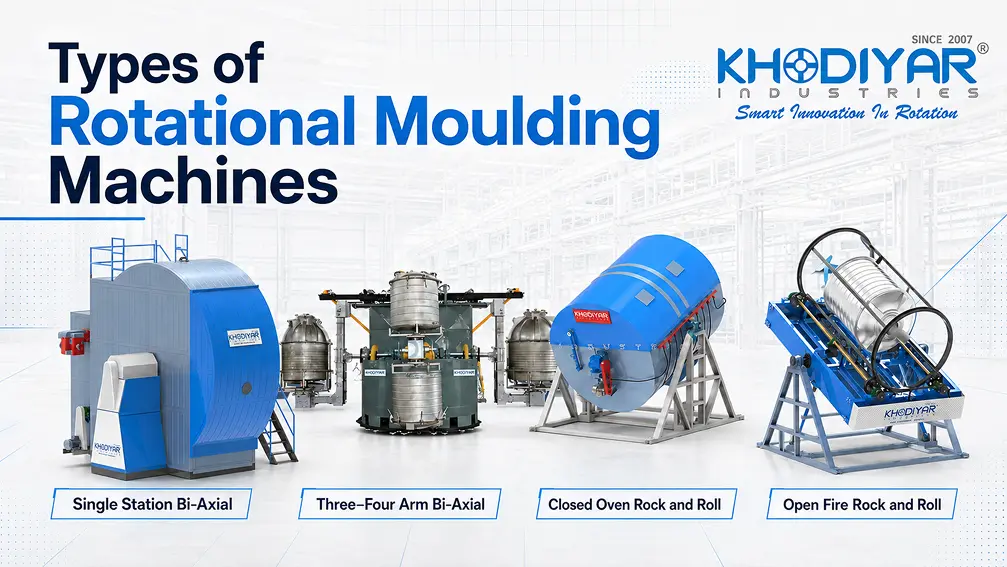
Machine type is decided by product shape and output volume, not by budget. Picking the wrong architecture is the most expensive mistake in this industry, because no amount of tuning will make a machine do work it was not built for.
Machine Type | Best Suited For | Typical Range | Stations |
Single station bi-axial | Small to mid-size tanks, startups, low floor space | 500 – 5,000 L | 1 |
Three arm bi-axial | Continuous production, mixed product sizes | 1,000 – 20,000 L | 3 |
Four arm bi-axial | High-volume tank plants running two shifts | 1,000 – 30,000 L | 4 |
Closed oven rock and roll | Long, narrow shapes; better heat retention | Up to 12,000 L | 1 |
Open fire rock and roll | Entry-level budgets, large single items | Up to 10,000 L | 1 |
If your product mix is mostly round vertical and horizontal tanks, a bi-axial arrangement will almost always be right. Businesses starting with one product line usually begin with a single station setup and expand later, while plants that need one mould heating while another cools move to three and four arm configurations. For long or asymmetric products, a closed oven rock and roll design holds heat far better, though an open fire variant remains the lower-capital entry point.
8 Factors to Check Before You Buy
1. Production Requirement and Capacity
Start with numbers, not brochures. Write down the largest product you intend to mould, its wall thickness, and how many pieces you need per day. From there, calculate the mould size, then the arm swing and oven chamber the machine must have to accommodate it – with headroom for the next product you plan to add.
A machine sized only for today’s bestseller becomes a bottleneck within two years. Always specify at least one capacity step above your current requirement, and confirm the arm can carry the loaded weight of your heaviest mould, not just its empty weight.
2. Build Quality and Durability
Roto moulding subjects a machine to repeated heating to 300 °C and back, with continuous rotation under load. That cycle finds every weakness in a frame. Look for heavy-gauge structural steel, properly stress-relieved weld joints, hardened gear systems, and quality bearings at the arm mounts.
Ask specifically about oven insulation thickness and material. Thin or poorly packed insulation is the most common cost-cutting shortcut, and it shows up later as slow heat-up, uneven cycles and a fuel bill that never comes down.
3. Heating System and Temperature Control
Heat distribution decides product quality more than any other single factor. Uneven heating produces thin spots, warping, bubbles and inconsistent wall thickness – all of which show up as field failures once tanks are filled.
A properly engineered machine uses forced-air circulation to move hot air uniformly around the mould, PLC-based control with programmable recipes for each product, and calibrated thermocouples that read actual oven temperature rather than burner output. Digital cycle logging is worth insisting on: it lets you reproduce a good batch instead of guessing at it.
4. Energy Consumption and Fuel Cost
Fuel is usually the single largest running cost in a rotomoulding plant, often exceeding labour. Two machines with identical output can differ by 25 to 30 percent in fuel consumption purely because of insulation quality, burner efficiency and air circulation design.
When comparing quotations, ask each supplier for fuel consumption per cycle at a stated product weight – not a general efficiency claim. Over a ten-year life, the difference between an efficient and an inefficient machine typically exceeds the purchase price gap several times over.
5. Moulding Precision and Wall Thickness Consistency
Precision comes from smooth, controlled rotation. Variable-speed drives on both the major and minor axes let you tune the rotation ratio for each product shape, which is how you control where material distributes inside the mould.
Check for backlash in the drive train and rigidity in the arm. Any play at the arm mount translates directly into uneven walls, and it worsens as the machine ages. For products that must hold liquid under load, wall consistency is not a cosmetic issue – it is the difference between a tank that lasts and one that splits.
6. Safety Features and Compliance
A rotomoulding machine combines open flame or high-temperature air, heavy rotating masses and hot moulds handled by operators. Non-negotiable features include emergency stop circuits at every station, overheat cut-off, flame failure detection on the burner, interlocked oven doors and guarding on all rotating components.
If you plan to export finished products or supply to organised buyers, confirm the machine is built to recognised electrical and mechanical safety standards. Retrofitting compliance later is expensive and rarely clean.
7. Customisation Scope
No two plants run the same product mix, and standard catalogue machines rarely fit exactly. Useful customisations include arm length and mould-mounting configuration, oven dimensions matched to your largest product, burner type selected for the fuel you actually have available, and automation level matched to your operator skill.
A manufacturer who builds to your specification rather than selling from stock will save you far more in avoided compromises than the small premium usually costs.
8. After-Sales Support, Spare Parts and Training
A rotomoulding machine is a fifteen to twenty year asset, and the supplier relationship lasts just as long. Before signing, establish four things in writing: installation and commissioning scope, operator training duration, spare parts availability and typical lead time, and the response time commitment for a breakdown.
Ask for reference customers running the same model, and call them. A day of unplanned downtime in a tank plant costs more than most spare parts inventories, and suppliers who cannot support what they sell are only cheap on the invoice.
Buyer’s Checklist Before Buying Roto Moulding Machine
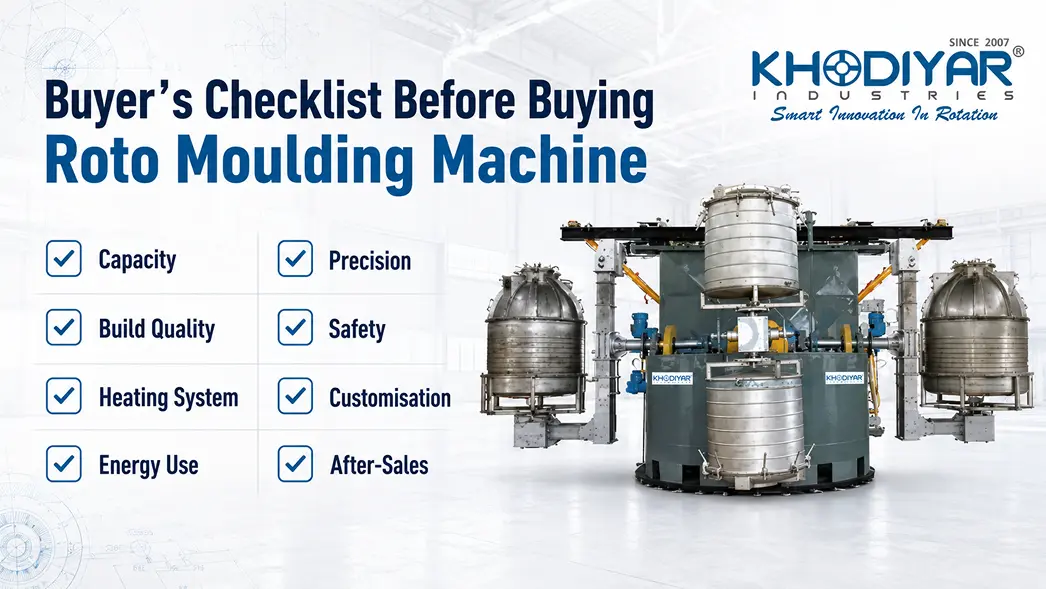
- Capacity – sized one step above current requirement, arm rated for loaded mould weight
- Build – stress-relieved frame, hardened gears, documented insulation thickness
- Heating – forced-air circulation, PLC recipes, calibrated thermocouples, cycle logging
- Energy – fuel consumption per cycle quoted at a stated product weight
- Precision – variable speed on both axes, minimal drive backlash, rigid arm
- Safety – e-stops, overheat cut-off, flame failure detection, door interlocks
- Customisation – arm, oven and burner matched to your product and fuel
- Support – written commissioning, training, spares and response-time terms
Budget vs Long-Term ROI: What Actually Matters
Purchase price is the most visible number and the least important one. The figure that decides profitability is cost per moulded piece over the machine’s life, and it is driven by fuel consumption, cycle time, scrap rate, maintenance spend and downtime.
A machine costing 15 percent less but consuming 25 percent more fuel and producing 4 percent more rejects will cost significantly more within three years — and it will keep costing more for another twelve. Before choosing on price, build a simple comparison of fuel per cycle, cycles per shift, expected scrap percentage and annual maintenance for each shortlisted machine. The answer usually reverses the ranking the quotations suggested.
5 Common Mistakes Buyers Make
- Buying for today’s order book. Capacity requirements grow faster than most owners plan for, and adding a second machine costs far more than sizing the first one correctly.
- Comparing only the machine price. Moulds, pulveriser, grinder, installation, electrical work and commissioning frequently add 30 to 40 percent to the total project cost.
- Ignoring the fuel type available at site. A machine configured for a fuel you cannot reliably source becomes an expensive conversion project before it ever runs at rated output.
- Skipping the mould discussion. Machine and mould must be engineered together – mould weight, mounting pattern and heat transfer characteristics all depend on the machine they run in.
- Not visiting the manufacturing facility. A factory visit tells you more about build quality and after-sales capability in two hours than any brochure or video call will.