


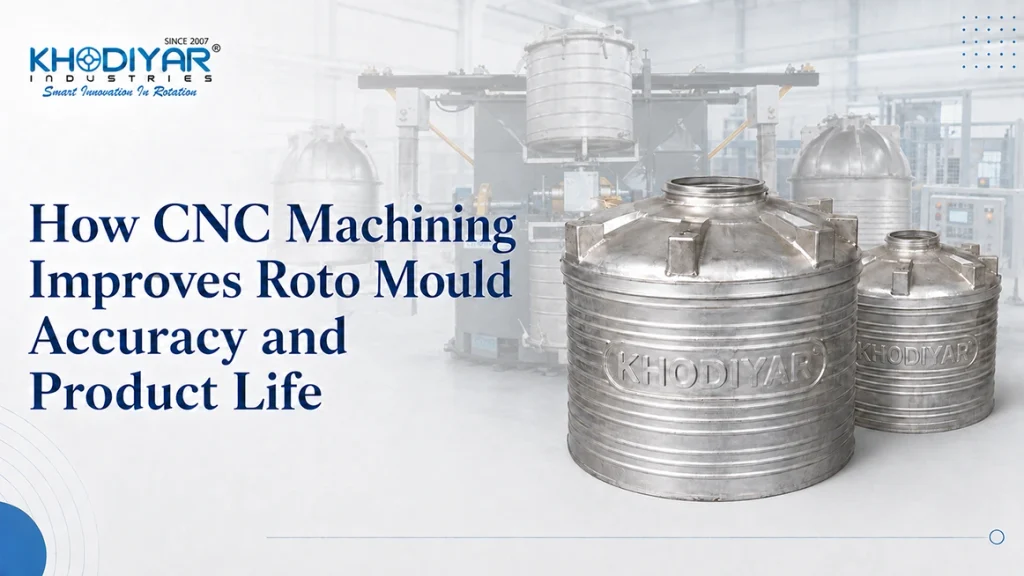
CNC machining improves rotational moulding accuracy by cutting the cavity directly from a solid aluminium billet to tolerances of roughly ±0.1 mm, against ±0.5 to ±1.5 mm for cast moulds. This delivers uniform mould wall thickness, flat parting lines and denser mould material – which together produce more consistent parts and a longer mould service life.
In rotational moulding, the mould does far more than hold a shape. It controls how heat reaches the polymer, how evenly the wall builds up, and what dimensions the finished part ends up with. Every imperfection in the cavity is copied onto every single part the mould produces, for its entire working life.
That is why the way a mould is made matters as much as the machine it runs on. This article explains what CNC machining changes, the accuracy it delivers in real numbers, how it affects mould life, and when the extra tooling cost is actually justified.
What Is CNC Machining in Rotational Moulding?
CNC (Computer Numerical Control) machining is a subtractive process: a computer-guided cutting tool removes material from a solid block until the finished shape remains. For roto moulds, this means cutting the cavity directly out of a solid aluminium billet instead of pouring molten aluminium into a sand pattern.
The workflow starts with a 3D CAD model of the product. CAM software converts that model into tool paths, and a 3-axis or 5-axis CNC machine cuts the cavity to those coordinates. Because the geometry comes straight from the digital file, the finished cavity matches the design within a fraction of a millimetre – with no pattern-making, no shrinkage allowance and no casting variation in between.
This matters more in rotational moulding than in most other plastic processes. Rotomoulding is a low-pressure process: there is no injection pressure forcing polymer into the cavity. The powder simply melts and fuses against the inner wall as the mould turns on both axes. Whatever the cavity looks like, the part copies it exactly – including its defects.
Why Mould Accuracy Matters More Than Most Rotomoulders Realise
Mould accuracy is usually discussed in terms of finished part dimensions. In practice its influence runs deeper, because the mould is also the heat exchanger of the whole process.
• Heat transfer is governed by mould wall thickness. Where the mould wall is thicker, heat arrives slower and the plastic wall builds up thinner. Uneven mould sections create hot and cold zones inside the same part.
• Defects are permanent and repeated. A scratch, a porous patch or a warped flange is reproduced on every part until the mould is repaired or scrapped.
• Errors compound across multiple moulds. A rotomoulder running four moulds of the same product on a multi-arm machine needs all four to produce interchangeable parts. Small tooling differences show up as inconsistent capacity and poor fitment.
• Tolerance stacking affects assembly. Lids, threaded outlets, moulded-in inserts and mating parts all depend on the cavity being where the drawing says it is.
Six Ways CNC Machining Improves Roto Mould Accuracy
1. Tighter dimensional tolerances. CNC machining typically holds ±0.1 to ±0.25 mm across the cavity. Sand-cast moulds generally land in the ±0.5 to ±1.5 mm range once pattern allowance and casting shrinkage are accounted for.
2. Uniform mould wall thickness. CNC cuts both the cavity and the outer profile to a controlled wall section throughout. Even mould walls mean even heat transfer, which is the single biggest factor behind consistent part wall thickness.
3. Flat parting lines and true flanges. Machined flanges sit flat within hundredths of a millimetre. That means less flash, no powder leakage at the seam, and clamping force spread evenly instead of concentrating on high spots.
4. Consistent, repeatable surface finish. Programmed tool paths produce the same finish across the entire cavity. Surface texture affects release behaviour, part gloss and how evenly powder tumbles and adheres during the heating cycle.
5. Precise placement of inserts and fittings. Outlet positions, threaded bosses and moulded-in inserts land exactly where the CAD model specifies. On water tanks, this is what keeps inlet and outlet fittings aligned across every unit produced.
6. True repeatability across multiple moulds. Running the same CAM program produces near-identical moulds every time. For anyone operating several cavities of the same product, this is what makes parts genuinely interchangeable.
Talk to Us About Your Mould Requirement
Khodiyar Industries has manufactured rotational moulding machines and moulds from Ahmedabad since 2007. If you are planning a new product and need help deciding between CNC machined, cast or fabricated tooling – and which machine configuration suits it – we can work through it with you.
Get a CNC Roto Mould QuoteHow CNC Machining Extends Roto Mould Life
Accuracy and durability are closely linked in rotational moulding, because a mould fails largely through repeated thermal stress rather than through wear.
• Denser material with no casting porosity. Billet aluminium is homogeneous throughout. Sand castings can contain porosity and inclusions, and those voids are exactly where thermal-fatigue cracks tend to start.
• Even thermal expansion. Uniform wall sections expand and contract evenly through every heating and cooling cycle. Uneven sections build internal stress that eventually appears as warping or cracking at corners.
• Lower clamping stress. Flat flanges spread clamp load evenly. A warped flange forces operators to over-tighten to stop leakage, and that distortion accumulates over hundreds of cycles.
• Cleaner demoulding. Accurate draft angles and smooth cavity surfaces let parts release without prying. Most physical damage to roto moulds happens during demoulding, not during heating.
• Simpler repair and re-machining. Because the original CAM program is retained, a damaged sealing edge or flange can be re-cut to the exact original coordinates. Restoring a cast mould to specification is far more difficult.
Actual service life always depends on resin type, oven temperature, handling discipline and cleaning routine – but a well-maintained CNC machined aluminium mould will generally outlast a cast equivalent used under the same conditions.
CNC Machined vs Cast vs Fabricated Roto Moulds
Each construction method has a legitimate place. The right choice depends on part geometry, production volume and how tight your tolerances really need to be.
| Factor | CNC Machined Aluminium | Cast Aluminium | Fabricated Mild Steel |
| Typical tolerance | ±0.1 – 0.25 mm | ±0.5 – 1.5 mm | ±1 – 3 mm |
| Mould wall uniformity | Excellent | Moderate | Varies with sheet |
| Surface finish | Excellent | Good | Fair |
| Heat transfer | Excellent | Excellent | Moderate |
| Complex detail / logos | Excellent | Good | Limited |
| Tooling cost | Highest | Medium | Lowest |
| Best suited to | Precision parts, high volume, fine detail | General purpose, medium volume | Large simple shapes, low volume |
Mould construction should also be matched to the equipment it runs on. Compact, high-volume items suit multi-arm biaxial machines, while long cylindrical products such as horizontal tanks are better handled on machines built for rocking motion. Large single items usually run best on a single station setup.
How Mould Accuracy Shows Up in Your Finished Product
Take a water tank as the clearest example. Across the range of products made by rotational moulding, tanks are where accuracy has the most direct commercial consequences.
• Stated capacity must be real. A tank sold as 1,000 litres has to hold 1,000 litres. Cavity variation translates straight into capacity variation, and that is a compliance and reputation problem.
• Thin spots fail first. Wall thickness variation determines where a tank cracks under water pressure and UV exposure over the years. The thinnest point sets the real service life of the product.
• Powder consumption drops. Rotomoulders routinely add extra powder so the thinnest point still meets minimum thickness. A mould with uniform walls narrows that spread, so less safety margin is needed on every shot.
• Fitment and assembly improve. Lids, threads and outlet fittings align consistently, which cuts rework at the assembly stage.
• Rejection rate falls. Fewer out-of-tolerance parts means less regrind, less wasted oven time and better throughput per shift.
These gains only hold if they are actually measured. Wall thickness checks, capacity verification and dimensional inspection at defined stages are what turn tooling accuracy into consistent output – the same principle behind a documented in-process inspection routine.
Is a CNC Roto Mould Worth the Extra Cost?
CNC machined moulds cost more upfront than cast or fabricated tooling. Whether that premium pays back depends almost entirely on volume and tolerance requirements.
CNC machining is usually worth it when:
• Production volume is high, so tooling cost spreads across many parts
• Capacity or dimensional tolerances are tight, or specified by a customer
• The part carries fine detail, logos, textures or moulded-in inserts
• You need several identical moulds that must produce interchangeable parts
• The product is branded or premium, where surface finish is part of the value
Cast or fabricated tooling is often the sensible choice when:
• The part is large and simple – bulk storage tanks, road barriers, large bins
• Volumes are low, or you are running a trial before committing to a design
• Tooling budget is the binding constraint on starting production
A practical middle path is to use CNC machining selectively – for the detailed, dimension-critical zones of a mould, and simpler construction elsewhere. This is common on production lines built around storage tanks, where the body is straightforward but the neck, outlets and lid seat demand precision.
Key Takeaways
• CNC machining holds roughly ±0.1–0.25 mm cavity tolerance, versus ±0.5–1.5 mm for cast aluminium moulds
• Uniform mould wall thickness drives even heat transfer, which is the main control on part wall consistency
• Billet aluminium has no casting porosity, so it resists thermal-fatigue cracking better over repeated cycles
• Flat machined flanges reduce flash, powder leakage and clamping distortion
• Better wall consistency lowers powder consumption per part, offsetting some of the higher tooling cost
• CNC moulds can be re-machined from the original program, making repair far more practical
Frequently Asked Questions
What tolerance can a CNC machined roto mould hold?
A CNC machined aluminium roto mould typically holds a cavity tolerance of ±0.1 to ±0.25 mm. Sand-cast aluminium moulds usually fall in the ±0.5 to ±1.5 mm range, and fabricated mild steel moulds wider still. The exact figure depends on part size, geometry and the machine used.
Is CNC machining better than casting for roto moulds?
For accuracy, surface finish and fine detail, yes. CNC machining cuts the cavity from solid billet, so there is no casting porosity and wall sections stay uniform. Casting remains a sensible choice for large, simple shapes where tight tolerances are not critical and tooling budget matters more.
Does a CNC roto mould reduce material cost per part?
It can. Rotomoulders often add extra powder to guarantee minimum wall thickness at the thinnest point of the part. A mould with uniform walls narrows that variation, so less safety margin is needed. Across thousands of parts, the powder saving adds up meaningfully.
How long does a CNC machined roto mould last?
A well-maintained CNC machined aluminium mould can run many thousands of heating and cooling cycles before major refurbishment. Actual life depends on resin type, oven temperature, demoulding practice and cleaning routine. Dense billet aluminium resists thermal-fatigue cracking better than porous cast material.