

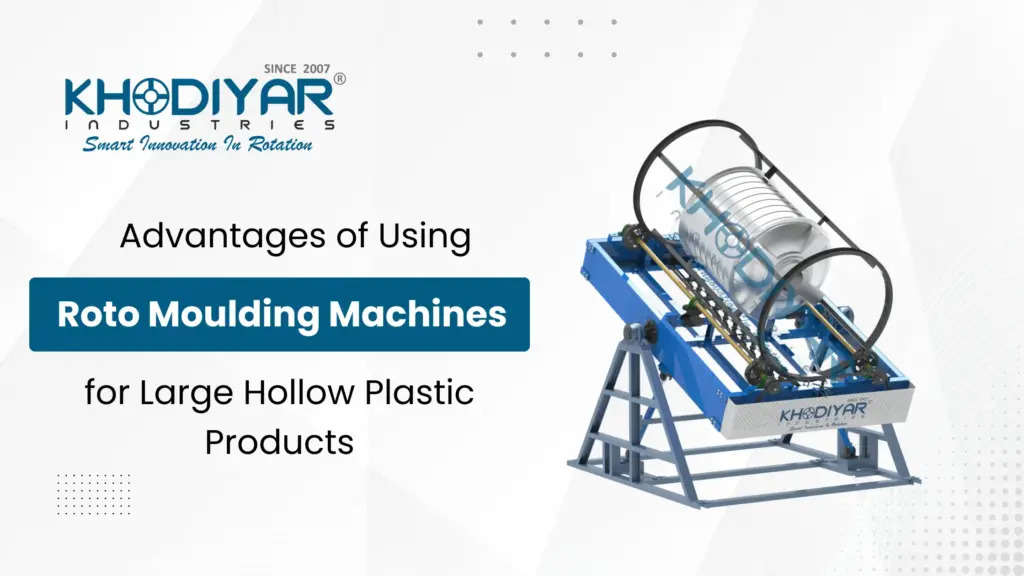
When it comes to manufacturing large hollow plastic products, not all production methods are created equal. Whether you are producing water storage tanks, playground equipment, industrial containers, or automotive parts, the choice of manufacturing process directly impacts your product quality, production cost, and long-term profitability. Among all available techniques, rotational moulding powered by advanced roto moulding machines stands out as the most efficient, cost-effective, and versatile solution.
At Khodiyar Industries, we have been at the forefront of rotational moulding machine manufacturing, helping businesses across India and beyond unlock the true potential of this transformative technology. In this blog, we break down the key advantages of using rotomoulding machines for large hollow plastic products.
What Is Rotational Moulding?
Rotational moulding, commonly known as rotomoulding, is a plastic manufacturing process in which powdered plastic resin is placed inside a hollow mould. The mould is then heated in an oven while being rotated simultaneously along two perpendicular axes. As the mould rotates, the plastic melts and coats the inner walls uniformly. Once cooled, the mould is opened to reveal a seamless, hollow plastic product.
This process is ideal for producing large, complex, and hollow plastic parts, something that other methods like injection moulding or blow moulding struggle to achieve efficiently.
1. Seamless, One-Piece Construction
One of the most significant advantages of roto moulding machines is their ability to produce seamless, one-piece hollow products. Unlike welded or assembled parts, a rotationally moulded product has no joints, weld lines, or seams. This makes the final product.
- Stronger and more durable — no weak points from welding or bonding
- Leak-proof — critical for tanks, containers, and fluid storage products
- More aesthetically refined — smooth, clean surfaces inside and out.
For large products like water tanks, chemical storage tanks, and septic tanks, this seamless construction is not just a feature; it is a necessity.
2. Cost-Effective Tooling for Large Products
Compared to injection moulding, roto moulding tooling costs are dramatically lower, especially for large products. Injection moulding moulds for large parts can cost several times more, while roto moulding moulds are typically made from aluminum or fabricated steel, both affordable and quick to produce.
This makes rotational moulding an ideal choice for:
- Short to medium production runs where high tooling investment is not justified
- Product prototyping and design testing at a fraction of the cost
- Custom or low-volume products that need unique shapes and sizes
At Khodiyar Industries, our roto moulding machines are engineered to work with a wide range of mould types, giving manufacturers maximum flexibility without inflating their capital expenditure.
3. Uniform Wall Thickness Across Complex Shapes
Achieving consistent wall thickness in a large hollow product is a challenge that many manufacturing methods fail to solve. With rotational moulding, the biaxial rotation of the mould ensures that the plastic resin distributes evenly across all surfaces, including deep corners, undercuts, and complex geometries.
This uniform wall thickness results in the following:
- Predictable structural performance
- Consistent weight across production batches
- Reduced material waste from over-thick or uneven sections
For manufacturers producing products that must meet strict dimensional and load-bearing standards, this consistency delivered by Khodiyar Industries’ rotomoulding machines is a major competitive advantage.
4. Design Freedom and Versatility
Rotational moulding offers extraordinary design flexibility. Designers and engineers can incorporate complex curves, internal threads, inserts, multiple wall layers, and even double-walled structures all within a single moulding cycle. This makes it possible to produce intricate products that would require multiple parts and assembly steps using other methods.
Products commonly manufactured using roto moulding machines include
- Water storage tanks (100 litres to 50,000+ litres)
- Kayaks and canoes
- Playground slides and equipment
- Industrial chemical containers and IBCs
- Fuel tanks and automotive components
- Traffic barriers and road safety products
- Material handling bins and pallets
The versatility of Khodiyar Industries’ rotational moulding machines means that a single production setup can handle a wide variety of product categories, giving manufacturers the ability to diversify without major reinvestment.
5. Minimal Material Waste: A Greener Manufacturing Option
Environmental responsibility is no longer optional in modern manufacturing. Rotational moulding is inherently a near-zero-waste process. The exact amount of plastic resin required for each product is loaded into the mould before heating. There are no sprues, runners, or gates, common waste sources in injection moulding.Additionally, any excess or scrap material generated can typically be reground and reused in subsequent production cycles, further reducing raw material consumption and waste disposal costs. By investing in rotomoulding machines from Khodiyar Industries, manufacturers are not only making a smart business decision but also committing to a more sustainable production model that aligns with global environmental standards.
6. Ability to Produce Very Large Products in a Single Piece
Perhaps no other manufacturing process matches rotational moulding’s ability to produce extremely large hollow products as a single piece. Injection moulding machines are limited by clamp force and mould size, and blow moulding is generally restricted to smaller, bottle-like geometries. Rotomoulding faces no such constraints. Tanks holding tens of thousands of liters, large playground structures, industrial pallets, and boat hulls are all routinely produced on roto moulding machines in one piece, without assembly.Khodiyar Industries designs rotomoulding machines in multiple configurations, including rock and roll machines, carousel machines, and swing arm machines, to accommodate products of virtually any size and weight requirement.
7. Lower Production Costs for Hollow Products
The rotomoulding process uses atmospheric pressure (as opposed to high-pressure injection or blow moulding), which reduces equipment wear, lowers energy consumption, and extends machine life. The combination of:
- Low tooling costs
- Minimal material waste
- Lower machine maintenance costs
- Simplified production process
makes rotational moulding the most cost-efficient choice for hollow plastic products, particularly at medium to large scales. For businesses looking to maximise margins without compromising on product quality, roto moulding machines from Khodiyar Industries deliver an exceptional return on investment.
8. Durability and Long Service Life of Moulded Products
Products manufactured through rotational moulding are known for their outstanding durability. The stress-free nature of the moulding process (no high pressure, no forced flow of molten plastic) means the finished product retains the full mechanical integrity of the raw material. Products can be made UV-stabilized, food-grade, antistatic, flame-retardant, or chemical-resistant by simply changing the resin compound.
This means the end products are fit for harsh outdoor environments, demanding industrial applications, and long-term use qualities that buyers of storage tanks, outdoor furniture, and industrial containers demand.
Why Choose Khodiyar Industries for Your Rotomoulding Machine?
With decades of experience in designing and manufacturing rotational moulding machines, Khodiyar Industries has earned the trust of manufacturers across diverse industries. Our machines are built with precision engineering, energy-efficient heating systems, and robust structural frames that ensure reliable performance across thousands of production cycles.
We offer:
- Customised machine configurations to match your product range
- After-sales technical support and operator training
- Durable moulds fabricated to your exact product specifications.
- Energy-efficient burner systems that reduce operating costs
Whether you are setting up a new production facility or upgrading your existing line, Khodiyar Industries is your ideal partner for rotational moulding success.
Conclusion
Roto moulding machines represent one of the smartest investments a plastics manufacturer can make, especially for large, hollow, and complex products. The combination of low tooling costs, design versatility, seamless construction, uniform wall thickness, and minimal waste makes rotational moulding the preferred choice for water tank manufacturers, industrial container producers, playground equipment makers, and many more. Khodiyar Industries brings this powerful technology to your production floor with machines built for performance, longevity, and profitability. If you are ready to elevate your manufacturing capabilities, contact Khodiyar Industries today and discover the difference that the right roto moulding machine can make.
Faqs
1. What is a roto moulding machine?
A roto moulding machine is equipment used in the rotational moulding process to manufacture hollow plastic products. The machine rotates a mould while heating it, allowing plastic resin to melt and coat the mould evenly from the inside.
2. Why is rotational moulding ideal for large hollow plastic products?
Rotational moulding is ideal because it can produce large, seamless, and durable hollow products in a single piece without joints or welding. This improves strength, leak resistance, and product life.
3. Are roto moulding machines cost-effective for large products?
Yes. Compared to injection moulding, rotational moulding requires lower tooling investment, reduced maintenance, and minimal material waste, making it highly cost-effective for large hollow plastic products.
4. How does rotational moulding ensure uniform wall thickness?
The mould rotates simultaneously on two axes during heating, allowing melted plastic to spread evenly across all surfaces. This helps achieve consistent wall thickness even in complex shapes.
5. Is rotational moulding suitable for custom product designs?
Yes. Rotational moulding offers excellent design flexibility and supports complex shapes, undercuts, inserts, double walls, and customized product sizes with minimal tooling modifications.
6. Does the rotomoulding process generate material waste?
Very little. Rotational moulding is considered a near-zero-waste process because the exact amount of plastic resin is used, and excess material can often be recycled and reused.