

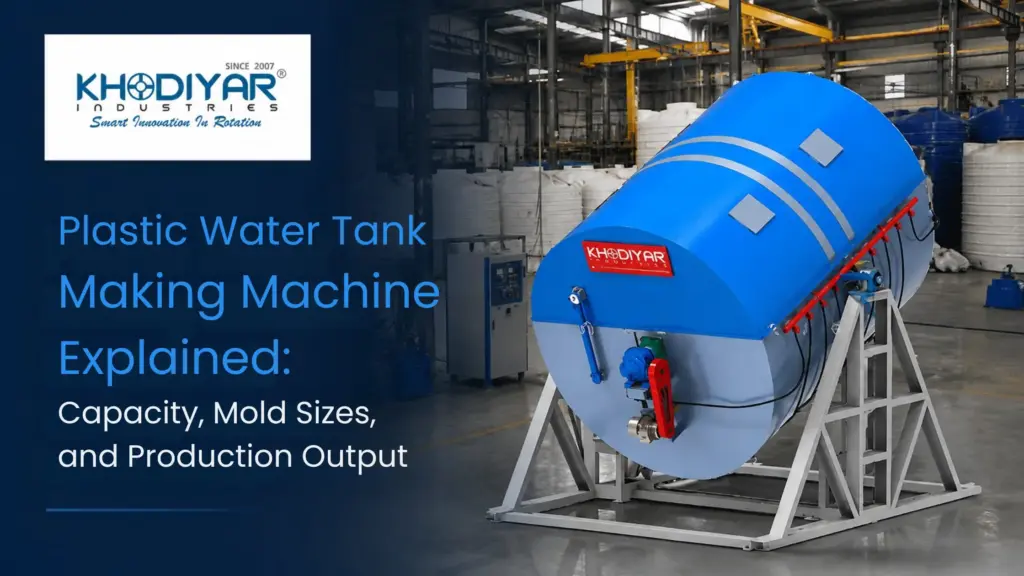
Selecting the correct plastic water tank manufacturing equipment is no small task for a tank manufacturing company. The choice of the appropriate equipment allows you to strike a balance between the factors of production, mold sizes, energy consumption, space requirements, and return on investment. In this article, we will take a look at the working principle, capacity, and mold size options, along with the production outputs.
What Is a Plastic Water Tank Making Machine?
The Plastic Water Tanks Molding Machine is an industrial machine used to convert powder (LLDPE/HDPE) into seamless tanks for storing water. This process involves heating a mold filled with the powder and then rotating it on two axes in order to uniformly coat the inside of the mold so as to create the walls of the tank. Since tanks made in this way are single units, there is no welding required; hence, rotomolded tanks are mostly preferred for storing water.
How Does a Plastic Water Tank Making Machine Work?
The working process follows four stages:
- Charging: A weighed quantity of LLDPE powder (often UV-stabilized and food-grade) is loaded into the mold.
- Heating: The mold rotates biaxially inside an oven at roughly 250–300°C, melting the powder so it fuses evenly across the mold wall.
- Cooling: Air and water spray cool the mold while rotation continues, ensuring uniform wall thickness and preventing warpage.
- Demolding: The finished tank is removed, trimmed, fitted, and inspected.
A complete cycle typically takes 40–90 minutes depending on tank size, wall thickness, and number of layers (single, double, triple, or four-layer foam-insulated tanks).
Types of Plastic Water Tank Making Machines
| Machine Type | Best For | Typical Tank Range | Output Level |
| Bi-Axial Roto Moulding Machine | Standard vertical water tank manufacturing, uniform wall thickness production | 200 L – 5,000 L | High |
| 3 & 4 Arm Bi-Axial Machine | Continuous large-scale production with multiple mould operations | 500 L – 10,000 L | Very High |
| Single Station Bi-Axial Machine | Small to medium production units, flexible batch production | 200 L – 3,000 L | Medium |
| Close Oven Rock N Roll Machine | Horizontal water tanks, septic tanks, large industrial hollow products | 500 L – 20,000 L | High |
| Open Fire Rock N Roll Machine | Cost-effective manufacturing for medium-scale tank production | 200 L – 5,000 L | Medium |
| Custom Roto Moulds + Tank Moulds | Vertical tanks, horizontal tanks, loft tanks, septic tanks, custom plastic products | Depends on mould size | Depends on machine setup |
Water Tank Making Machine Capacity and Mold Sizes Explained
Machine “capacity” usually refers to the maximum swing diameter, the largest mold the arms can rotate. Common configurations:
- 1,000-1,500 mm swing: molds for 200 L to 1,000 L tanks
- 1,600-2,500 mm swing: molds for 1,000 L to 5,000 L tanks
- 3,000-4,500 mm swing: molds for 10,000 L to 25,000 L tanks
There is a standardization of mold size according to market demands: the most common mold sizes in various places are 500 L, 750 L, 1,000 L, and 2,000 L molds, which constitute the majority of orders placed by customers; hence, mold makers usually begin production from these sizes before moving on to bigger molds according to demand increase. Aluminum molds and mild steel sheet molds exist.
Production Output: What Can You Realistically Expect?
Daily output depends on machine type, arm count, and shift pattern:
- Single-station biaxial machine: 15–25 tanks (1,000 L class) per 8-hour shift
- Three-arm carousel: 40–60 tanks per shift, since heating, cooling, and demolding run simultaneously
- Rock and roll machine: 6–12 large tanks per shift
Multi-layer tanks reduce output by 20–30% due to additional powder drops, but command higher selling prices. For accurate ROI planning, calculate output in kilograms of polymer processed per hour rather than tank count alone.
Industrial Applications
Beyond domestic water tanks, the same machine produces septic tanks, chemical storage tanks, agricultural sprayer tanks, road barriers, dustbins, planters, and insulated containers, letting manufacturers diversify revenue from a single asset.
Why Choose a Plastic Water Tank Making Machine?
Procurement teams and factory owners should evaluate the following:
- Swing diameter and oven size matched to your largest planned tank.
- Fuel type and consumption (LPG, PNG, diesel, or electric) typically the highest operating cost
- Cycle time and automation level (PLC control, temperature data logging)
- Compliance: tanks should meet IS 12701 (India) or equivalent national standards, and machines should come from ISO 9001-certified manufacturers
- Spare-part availability and service support in your region
- Power load, foundation, and shed height requirements
Industry Trends and ROI Outlook
The need for rotomolded tanks keeps increasing with the construction of more homes as well as rural water-supply initiatives and rainwater harvesting systems. The trend in manufacturing is now towards energy-saving ovens, recycling layers, and four-layer insulated tanks for high-end models. In an optimally used single biaxial machine making average 1,000-liter tanks, the return on investment will be realized between 18 and 30 months.
Conclusion
The water tank manufacturing machine can be seen as an investment in the long run since it is a production tool. Getting the best machine involves ensuring that its swing diameter and oven size suit the best-sold capacities of the water tank and validation of cycle time prior to purchase. Begin with the most popular capacities, such as 500 L, 1000 L, and 2000 L, and consider the number of kilograms of polymer produced per hour. Also, consider the amount of fuel used by the machine during production in your ROI calculations. Most companies recover their costs within 18-30 months and can develop other rotomolding products, including septic tanks and chemical tanks, among others.
Ready to Start or Scale Your Water Tank Manufacturing Business?
At Khodiyar Industries, we help manufacturers choose the right plastic water tank making machine for their capacity goals and budget.
Frequently Asked Questions
1. What is the cost range of a plastic water tank making machine?
Cost varies depending on the type and swing diameter of the machine. An open flame machine is way cheaper than an automated carousel machine. You can get a quotation based on the target capacity of the tanks you want to manufacture and the number of tanks you will make each day.
2. What is the production capacity of a plastic water tank making machine per day?
On average, a single-station machine biaxially makes 15-25 tanks of 1,000 liters per shift, while a three-arm carousel machine makes 40-60 tanks per shift.
3. What is the raw material used for a plastic water tank making machine?
Linear low-density polyethylene powder, UV-stabilized and food-grade for potable water tanks.
4. What tank sizes can a single machine make?
The tank capacity varies depending on swing diameter and can make molds starting from 100L to 25,000L. Most of the manufacturers have molds of 500 L, 1,000 L, and 2,000 L.
5. What space/power consumption does the machine require?
On average, 3,000-5,000 square feet of shed space, depending on swing diameter and adequate height.