
Plastic Water Tank
Making Machine
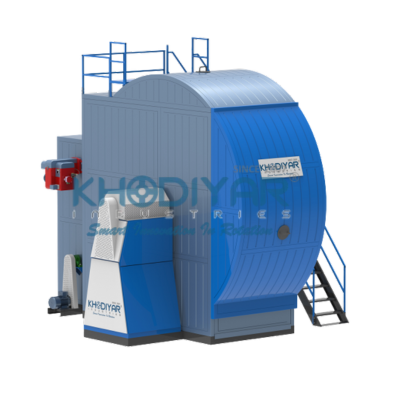
A plastic water tank making machine is a rotomoulding machine that heats LLDPE powder inside a rotating mould to form seamless, one-piece water tanks. Khodiyar's 3-arm and 4-arm models produce tanks from 100L to 10,000L by changing the mould.
Plastic Water Tank Making Machine
Plastic water tanks are now the standard choice for homes, farms and industry across India, which makes tank production a steady, scalable business. The same machines also make agricultural and irrigation tanks, chemical storage tanks, septic tanks and industrial containers, so one plant can serve several markets. The machine you choose decides your output per shift, fuel bill, tank quality and how quickly you recover your investment.
Khodiyar Industries has built rotomoulding equipment in Ahmedabad, Gujarat, since 2007. This guide explains how a water tank making machine works, what separates a good machine from an average one, and what to check before you buy.
What Is a Plastic Water Tank Making Machine?
A plastic water tank making machine is a rotational moulding machine designed for hollow, seamless tanks. Instead of injecting or blowing plastic, it melts polymer powder inside a closed mould while rotating it on two axes, so the plastic coats the inside walls evenly.
A typical water tank manufacturing machine has five main parts:
Oven
An insulated chamber with a burner that heats the mould, typically to 250–350°C.
Arms
Carry the moulds between stations. Multi-arm machines heat one mould while another cools and a third is unloaded.
Bi-axial drive
Rotates the moulds on two axes at once for uniform wall thickness.
Cooling station
Fans and, on some models, water mist to cool the mould in a controlled way.
Control panel
Sets oven temperature, rotation speed and cycle times.
The moulds themselves, usually fabricated from mild steel or stainless steel, decide the tank's shape and size. Khodiyar also manufactures roto moulds for vertical and horizontal tanks in a range of sizes.
How Rotational Moulding Works
Material loading
A measured quantity of LLDPE powder is loaded into the mould. The weight sets the tank's wall thickness.
Heating and rotation
The arm moves the mould into the oven, where it rotates on two axes. The powder melts and builds up evenly on the inner walls.
Cooling
The mould moves to the cooling station and keeps rotating while the plastic solidifies, which prevents warping.
Demoulding and quality check
The finished tank is removed, inspected for wall thickness and finish, and fitted with inlets and lids.
On a multi-arm machine, these stages run at the same time on different arms, which is why 3-arm and 4-arm machines deliver much higher output than single-station designs.
Why Rotomoulding Suits Water Tanks
In India, roto-moulded polyethylene water storage tanks are covered by BIS standard IS 12701, so good process control matters for certification as well as quality.
Features of a High-Quality Water Tank Making Machine
Not every rotomoulding machine is built for continuous water tank production. These are the specifications worth checking.
Key specifications
| Model | Arms | Maximum tank capacity per cycle | Total load |
|---|---|---|---|
| KI-3 / 1000 x 2 | 3 | 1000L ×2 | 19 HP |
| KI-3 / 2000 x 2 | 3 | 2000L ×2 | 27 HP |
| KI-4 / 1000 x 2 | 4 | 1000L ×2 | 22 HP |
| KI-4 / 2000 x 2 | 4 | 2000L ×2 | 32 HP |
| KI-4 / 5000 x 1 | 3 + 1 offset | 5000L ×2 | 48 HP |
Each model can also run several smaller moulds per arm. Full configurations are on the 3 and 4 arm bi-axial machine page.
Features that make a difference
Heavy-duty frame and arms
Stay aligned under large moulds and years of heat cycles.
Energy-efficient burner and oven insulation
Khodiyar's burner design is rated for up to 20% fuel savings. Fuel is one of the largest running costs in rotomoulding.
Quick mould changeover
So you can switch between 500L and 2000L tanks without losing a shift.
Accurate speed and temperature control
For uniform walls and consistent tank weight.
Low-maintenance drives and bearings
With easy access for servicing.
For smaller tanks, prototypes or very large one-off products, a bi-axial machine or open fire rock n roll machine may suit you better.
Choosing a Plastic Water Tank Making Machine Manufacturer
There are many suppliers, but these criteria help you choose a reliable water tank making machine manufacturer in India:
Experience in rotomoulding
Look for a manufacturer that specialises in rotational moulding machines, not general fabrication.
Complete solution
Machine, moulds, pulverizer and high speed mixer from one supplier means fewer compatibility problems.
Proven installations
Ask for references and visit a running plant. Khodiyar's gallery shows completed machines.
Quality processes
Check how frames, burners and electricals are tested. See Khodiyar's quality standards.
Installation and training
Khodiyar includes installation, commissioning and operator training with every model, typically completed in 3 to 7 working days.
After-sales support
Spare parts, service response and mould modifications keep your plant running.
Pricing Overview
Buyers often search for a single plastic water tank machine price, but the cost depends on configuration. The main factors are:
- Number of arms: 4-arm machines cost more than 3-arm machines but deliver higher output per shift.
- Maximum tank size: larger ovens and arms for 5,000L or 10,000L tanks need more steel, burner capacity and power.
- Number and type of moulds: each tank size needs its own mould, and stainless steel moulds cost more than mild steel.
- Burner and fuel type: diesel, gas or dual-fuel burners vary in cost and running expense.
- Automation and controls: digital control panels and timers add to the price but improve consistency.
- Ancillary equipment: pulverizers, mixers and cutters for an in-house powder line.
For an accurate price for your capacity and budget, request a free quote. Khodiyar aims to reply within 24 hours.
Conclusion
A plastic water tank making machine is a long-term investment, and the right choice depends on your target tank sizes, daily output and fuel costs. Choose a machine with a solid frame, an efficient burner, accurate controls and a manufacturer that supports you with moulds, installation and service.
Since 2007, Khodiyar Industries has helped tank manufacturers across India set up reliable rotomoulding plants. Share your capacity plans with our team and get a free machine quote today.
Get a Free
Machine Quote
Tell us your requirements: tank size range, production capacity, fuel preference. We'll send you a detailed quotation within 24 hours.
Send Enquiry
Fill in your details and we'll get back to you with a free quote.
Frequently Asked Questions
Everything you need to know about plastic water tank making machines. Still have questions? Contact us directly.
For most commercial producers, a 3-arm or 4-arm bi-axial rotomoulding machine is the best choice because multiple arms heat, cool and unload moulds at the same time. Single-station or rock n roll machines suit lower volumes or very large tanks.
Most tanks are made from rotomoulding-grade LLDPE (linear low-density polyethylene) powder with UV stabilisers. Multi-layer tanks may use a food-grade inner layer and a coloured or carbon-black outer layer.
One machine can make many sizes by changing moulds. Khodiyar's models cover tanks from 100L to 10,000L, depending on the machine's maximum capacity.
Yes, rotomoulding supports multi-layer tanks, such as a UV-stabilised outer layer with a food-grade inner layer. Layers are added in sequence during the heating cycle. Discuss your layer requirements with the manufacturer so the machine, controls and moulds are configured correctly.
It depends on the model. Khodiyar's machines range from 19 HP and about 11.5 × 11 × 6 metres for the KI-3 / 1000 x 2, up to 48 HP and about 19 × 14 × 7.5 metres for the KI-4 / 5000 x 1.
A 3-arm machine suits producers starting out or running a moderate daily output. A 4-arm machine adds an extra station, so more moulds are in process at once, which raises output per shift. Base the choice on your target daily volume and the tank sizes you plan to sell.
Raw material is usually the largest cost per tank. Among operating costs, labour and fuel are the biggest, followed by power and maintenance. An efficient burner, good oven insulation, well-balanced moulds and accurate cycle times all reduce fuel use and cost per tank.